Internal SEAH is a critical institutional accountability issue. IFIs are directly responsible for preventing and responding to misconduct by their own personnel (like any other organisation). IFIs typically use the term “internal SEAH” to describe sexual misconduct where the perpetrator is a staff member, a consultant, a Board official or contractor, whereas the victim can be either another staff member (in the case of sexual harassment), or a non-staff individual including a project beneficiary or community member (in the case of sexual exploitation and abuse). IFIs’ credibility in external engagement depends significantly on the strength, coherence and transparency of their internal systems for addressing misconduct.
PSEAH in IFIs: Progress, Gaps and the Road Ahead

Internal misconduct: Preventing and respond ton SEAH within the institution
Prevention: Strengthening recruitment and screening
Recruiting the right people is the first step in preventing SEAH within organisations. Most IFIs have introduced preventive measures at the hiring stage to avoid rehiring perpetrators across the sector. The degree of institutionalisation varies across IFIs. Many now request disclosure of prior misconduct, conduct reference checks and examine employment history for indications of SEAH-related concerns. The strongest example is IFAD, whose 2018 PSEAH Policy requires background checks for all personnel and third parties as part of mandatory preventive measures (IFAD, 2018[15]).
Concerns about “pass-the-harasser” risks have encouraged IFIs to explore collaboration, but no shared system yet exists. Interviews indicate that several institutions are considering ways to prevent individuals dismissed for SEAH from moving among organisations. However, this work remains exploratory, and no common framework or agreement has been formalised (Box 5.1). IFIs have voiced concerns in interviews about data protection obligations, procedural safeguards, and harmonisation with internal standards for due process.
Preventing SEAH by not rehiring past offenders
Several initiatives are underway to share data in due diligence for hiring processes to avoid appointing individuals with a track record of sexual misconduct.
ClearCheck
The UN ClearCheck system is a secure online platform set up by the UN Secretariat in 2018. UN entities can use it to share information on individuals in the UN system against whom SEAH allegations have been established, to prevent re-employing them in the UN system. ClearCheck encompassed 43 participating UN entities as of November 2025. IFAD and World Bank Group are the only IFIs participating in ClearCheck.
Misconduct Disclosure Scheme (MDS)
The MDS facilitates sharing of misconduct data between employers primarily outside the UN system. As of 2025, over 320 organisations contribute to it. These are mostly civil society organisations, but also include several UN organisations (UNDP, UNFPA, UNHCR, and UNOPS). Some IFIs – including IFAD – are currently assessing the legal and operational implications of participation.
Other avenues for responsible data sharing with IFIs and development banks
The IFI Heads of Integrity Working Group is defining a framework to share information when staff employment is terminated for misconduct to help prevent re-hiring staff suspended for misconduct. It is especially relevant given increasing IFI collaboration. IFIs noted clear policies ensuring fairness, transparency, and compliance with privacy frameworks must guide such engagement.
Project Soteria’s security check
INTERPOL’s Project Soteria, under a cooperation agreement, complements existing initiatives by enabling IFIs and their contractors to conduct security checks to ascertain whether staff members are or have been associated with ‘adverse information’ related to SEAH. This includes but is not limited to criminal convictions. IFIs and their contractors can also share substantiated misconduct reports with INTERPOL to help build a centralised repository on SEAH offences.
Sharing misconduct records from operations
Sharing information about non-staff perpetrators of SEAH in operations entails additional complexities. It requires data on implementing partners and their staff, which is usually managed by national authorities. UN agencies are beginning to include non-staff contractors in ClearCheck, but IFIs would need to rely on national databases, which only record criminal convictions and cannot track offenders across jobs. The World Bank’s Voluntary Disclosure Program (VDP) allows companies that uncover misconduct to proactively and confidentially disclose it to the World Bank without risking debarment. However, this programme only covers fraud and corruption.
IFIs are continuing to explore possibilities to share such information, carefully considering legal aspects and the duty to respect privacy and human rights. This should continue to be balanced against the risk of hiring an established perpetrator.
Source: IFAD written inputs sent to MOPAN (July 2025); Factsheet on ClearCheck (2025), Interview with UN Secretariat (11 September 2025), Misconduct Disclosure Scheme, Website, https://misconduct-disclosure-scheme.org/, visited 11 September 2025; Interpol, Project Soteria, https://www.interpol.int/en/How-we-work/Safeguarding-vulnerable-communities/Project-Soteria, visited 11 September 2025.
IFAD and the World Bank Group are in a particular position in this regard as they participate in joint UN efforts, including ClearCheck (Box 5.2). IFAD has committed to report allegations to iReport (although its entries currently lack detail). In addition to participating in ClearCheck, they participate in the UN Chief Executives Board, including its annual survey of CEB entities on reporting of sexual harassment, and in the annual staff survey on SEA organised by the UN Special Coordinator for SEA and submit annual action plans and management letters to the Secretary-General to report on progress.
Box 5.2. The World Bank Group’s joining ClearCheck
Before joining ClearCheck in 2024, the World Bank Group had to take the following actions*:
· Revise its pre-employment questionnaire to include questions about termination due to misconduct or pending misconduct proceedings/investigations.
· Verify that its staff rules allowed for disclosure of misconduct information to other entities.
· Inform all staff through a kiosk announcement that a finding of sexual misconduct resulting in termination of employment will lead to inclusion of the perpetrator’s name in the ClearCheck database.
*Information on the joining process was obtained from World Bank in email correspondence on 3 December 2025.
Behavioural expectations: Codes of Conduct and institutional norms
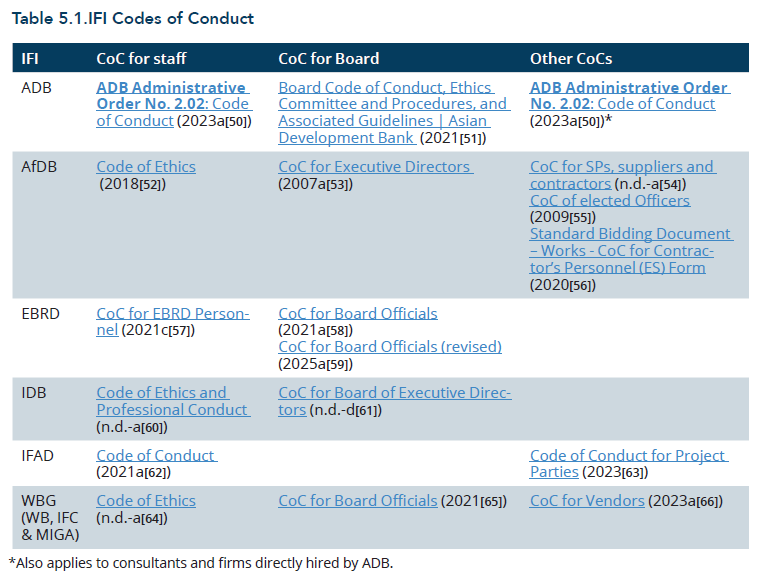
Codes of Conduct (CoCs) are the primary tool through which IFIs prohibit internal SEAH and define behavioural expectations for staff. They frame sexual misconduct in different ways. Most identify and define only sexual harassment; the World Bank also identifies SEA as misconduct in its Staff Directives. ADB is the only IFI to include sexual assault.
Most IFIs have also developed CoCs covering executive boards, representatives and elected officials, and consultants to expand protections against SEAH and other forms of misconduct (see Table 5.1). Contractual obligations aligned to the CoCs are included in non-staff contracts. EBRD’s 2025 Code is Board‑approved.
Training reinforces these norms but is not used consistently. Mandatory induction training on workplace conduct, sexual harassment prevention and reporting obligations is common. But MOPAN assessments found variability in refresher training, monitoring of completion rates and the degree to which training content is updated to reflect evolving policy and risk patterns. EBRD imposes departmental financial penalties for failure to complete training. The World Bank Group’s ethics and HR offices, with senior management, hold townhalls and establish task forces to address sexual harassment and raise visibility.
In some IFIs, outreach extends to country offices through ethics “road shows” and identification of focal points in field offices. The World Bank and ADB back this up with decentralised networks of focal points.
Some IFIs use staff surveys to track awareness, trust, and collect suggestions for improvements, including on PSEAH (Annex B, element 4.8.4). ADB, IDB, World Bank, IFAD and AfDB conduct such staff surveys, which interviewees perceive as helping to gauge confidence.
Response mechanisms: The internal justice ecosystem
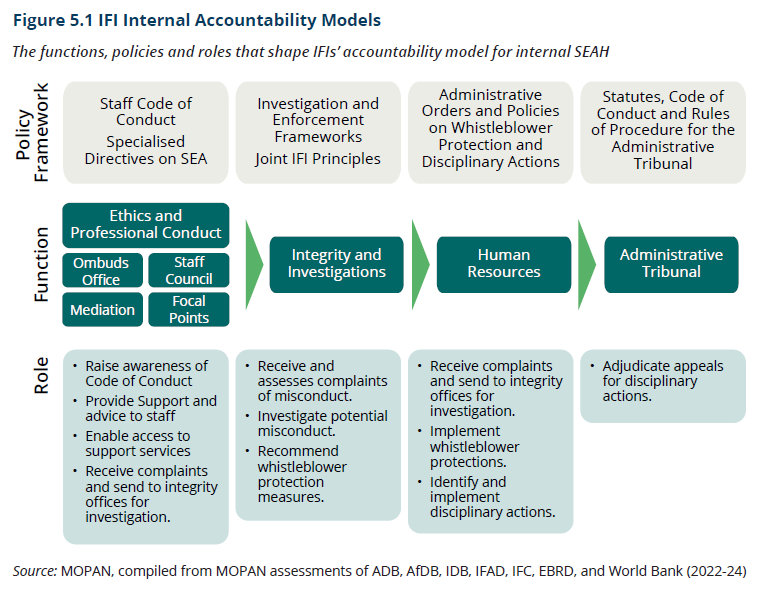
Across IFIs, many specialised actors with different roles handle internal SEAH allegations and generally form a complementary “ecosystem” (see Figure 5.1). This typically includes ethics offices, misconduct or integrity units, ombuds services, HR departments and administrative tribunals. These bodies provide intake, triage, investigation, advice, dispute resolution, disciplinary actions and appeal processes. Structures differ, but most IFIs design these systems to ensure independence, confidentiality and procedural fairness. Internal justice functions typically have their own ringfenced resources identified as part of the administrative budget, approved by the board of directors. Ethics, integrity and HR functions are usually represented at a very senior level within the institution, including separate vice presidencies that report to the president and/or the board of directors, with variation in the model (Annex B, element 4.8.3).
MOPAN assessments of IFAD, ADB, and the WBG in addition to interviews with IDB and EBRD suggest that CoCs and internal justice systems are beginning to make a difference. Although the number of formally reported cases remains low, these IFIs report a rise in staff SEAH complaints year on year and note that this is taken as a sign of greater trust in the system (see Annex B, element 4.8.7). At the same time, IFIs recognise that many concerns may be addressed through informal or preventative measures, which can limit the volume of formal reporting.
Complaints mechanisms and incident reporting
Internal grievance mechanisms
Staff can report misconduct through multiple channels, but fear of retaliation and uncertainty about outcomes remain barriers. IFIs allow confidential reporting through any of the internal bodies that make up the internal justice system (ethics offices, integrity or investigations teams, Ombuds, staff council, focal points or mediators, or HR), anonymous platforms or managers. EBRD maintains a mandatory duty to report all misconduct, including SEAH, under its CoC (EBRD, 2021c[57]). At the WBG, a dedicated unit within the ethics and internal justice services unit handles internal SEAH cases. IDB also identifies specific coordinators to manage misconduct complaints and regularly follow up with survivors.
Despite such provisions, staff in IFIs often hesitate to report due to concerns about retaliation or loss of confidentiality. Where staff lack trust in bank-owned mechanisms, one attempt has been to hire an external company to provide a separate confidential means for staff to report misconduct (AfDB), though the effectiveness of this model remains under review. Anti-retaliation policies exist across institutions, but interviews suggest uneven enforcement. This gap between formal policy and staff perception weakens trust in internal accountability systems.
How victims of SEA outside the organisation would lodge a complaint against a member of staff is largely unclear. Although mechanisms for reporting internal misconduct are open to them, it is unlikely that they would know how to access those (e.g. internal HR mechanisms). (Annex B, elements 4.8.2 and 4.8.3 contain more detail about the mechanisms and structures for reporting SEAH seen across the IFIs.)
Across IFIs, public reporting on internal SEAH cases is dispersed across multiple mechanisms. Few institutions provide aggregated data on numbers of allegations, substantiation rates, closure timelines or disciplinary outcomes. Each function — ethics, integrity, HR, or internal justice units — produces its own annual public report on queries, complaints, investigations, and disciplinary action. Also, numbers reported concern sexual harassment; where SEA cases would be listed is largely unclear, In short, no single report shows numbers that follow a case from complaint to disciplinary outcome. Table 5.2 shows where IFIs publish internal sexual misconduct data, and what information these reports provide.
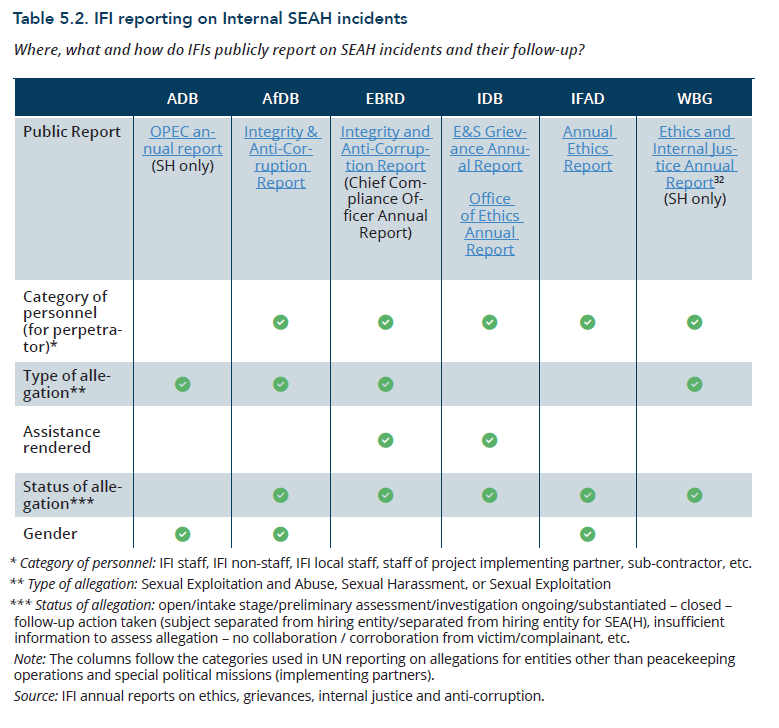
MOPAN assessments and interviews highlighted several examples of reporting, most of which is incomplete:
- ADB reports consolidated annual figures to governance committees but faces whistle-blower protection gaps and lengthy processes.
- AfDB plans to aggregate anonymised data once cases arise.
- World Bank includes SH sections in ethics reports and publishes sanctions lists.
- IDB reportedly shares updates via annual reports and sometimes through internal blogs, but interviewees noted that internal communication about SEAH was not yet sufficiently visible and required strengthening.
- EBRD publishes a single integrity and anti-corruption annual report that includes activities of both the ethics and investigation teams. It shares anonymised disciplinary outcomes and publicly disclosed one case, which it noted built staff engagement and improved staff trust.
- IFAD reportedly reflects all (internal) SH and SEA data promptly and securely on the member states interactive platform, accessible to executive board members as well as to the UN’s iReport system.
The fragmentation of data makes end-to-end tracking of internal SEAH cases difficult. This lack of transparency limits institutional learning and weakens accountability to staff and shareholders. It can also undermine trust in internal justice systems. Communicating anonymised case summaries to staff, clearly listing outcomes and sanctions, is important for demonstrating fairness and building trust.
Only EBRD and the World Bank use these numbers to identify trends. The World Bank also highlights lessons from specific cases such as the need for special survivor protection for contractors, which suggests a path forward for expanding reporting to address not just the question of “how many” but also “what was learned”.
IFI collaboration on internal accountability is emerging but remains limited
Collaboration on PSEAH across internal functions is rare (see Annex B element 4.8.7). Nonetheless, recent developments suggest a growing interest and commitment to joint learning through existing fora. All IFIs in this study participate in the Ethics Network of Multilateral Organisations, which they see as a key forum for sharing practices and lessons on issues such as sexual misconduct. Heads of Investigations meet annually at the International Conference of International Investigators and all IFIs except IFAD meet annually for the Independent Accountability Mechanisms Network to discuss common issues. Joint outputs so far include Principles and Guidelines for Investigations that integrity/compliance functions use and that protect complainants and respondents, to which the World Bank, AfDB, IDB, ADB, and EBRD contributed (ADB, AfDB, EBRD, EIB, IDB, IMF, WB, 2006[67]). In addition, the World Bank and IFAD engage through the UN Chief Executives Board, while 2-3 representatives of MFI/Development Finance Institutions participate in the Cross-Sector Safeguarding Steering Group led by the UK government. Beyond this, collaboration remains fragmented.
References
34.
The most recent EIJ report of the World Bank (FY 2024) has not yet been published; we are therefore referring to the FY23 edition.
↩