Background on SEAH
Addressing sexual exploitation, abuse and harassment (SEAH) is challenging and complex. The emergence of the first prominent allegations of SEAH in the multilateral system, related to UN Peacekeeping during the early 1990s, has sparked more than three decades of efforts to protect from sexual misconduct, with children disproportionately affected. Sex-for-aid scandals in West Africa brought this reality to global attention in 2002. International financial institutions (IFIs) also came under greater scrutiny as their large-scale projects, especially in post-conflict and humanitarian settings, carried risks of unintended harm.
Starting in the 1980s, organisations began, first, to address the potential environmental impacts of projects, shortly thereafter began to include social safeguards among other things. By the 2000s, the lens broadened as IFIs began to integrate gender-sensitive practices into their safeguard frameworks to promote equity and inclusion, while also helping to prevent and respond to gender-based violence (GBV). IFC’s 2012 standards, for example, addressed workplace sexual harassment and GBV risks in development projects2, while ADB3 (2009 revised Safeguard Policy), EBRD and IDB4 updated policies to incorporate GBV and SEA (see Table 1.1) and grievance mechanisms (GMs). The urgency of these reforms became clearer in the 2010s when high-profile IFI cases (e.g. IFC in Kenya, World Bank in Uganda)5 showed that SEAH risks extended well beyond humanitarian settings
For IFIs, 2018 was an important year for addressing SEAH. They issued their first joint statement on the continuous advancement of standards to prevent sexual exploitation, abuse and harassment at the Safeguarding Summit in London. The World Bank published its Good Practice Note on Addressing Gender-Based Violence in Investment Project Financing involving Major Civil Works (revised 2023), the first guidance in the development finance space dedicated specifically to SEA caused by development finances. Through these efforts, the SEAH agenda became closely linked to the wider drive to promote gender equality, including the prevention of GBV.
A year later, in 2019, donors issued the OECD-DAC Recommendation on Ending SEAH in Development Co-operation and Humanitarian Assistance. Bilateral donors committed to ending SEAH in their development and humanitarian cooperation, including in their multilateral funding and support to IFIs. They also agreed to build on their commitments at the 2018 London Summit, including to working with MOPAN to help improve multilaterals’ approach to PSEAH6. Most recently, in 2023, several institutions represented the IFIs on a cross-sector international steering committee to develop a Common Approach to Protection from Sexual Exploitation, Sexual Abuse, and Sexual Harassment (CAPSEAH). Launched in June 2024, CAPSEAH is designed to guide people and organisations working in Humanitarian, Development, Peace (HDP) and other sectors to align their efforts to protect from SEAH.
Background to this study
To better understand and monitor the progress of the multilateral system on this issue, the Multilateral Performance Network (MOPAN) integrated PSEAH into its assessment framework in 2020. MOPAN’s PSEAH benchmarks drew on international norms and good practices, including the Inter-Agency Standing Committee’s (IASC) Six Core Principles and Minimum Operating Standards and the OECD Development Assistance Committee’s (DAC) Recommendation on Ending Sexual Exploitation, Abuse, and Harassment in Development Cooperation and Humanitarian Assistance. In addition, four case studies, one of which included the World Bank, further refined the benchmarks.
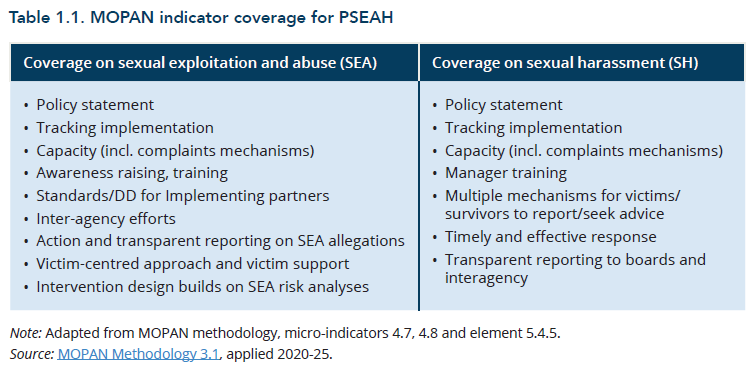
MOPAN’s PSEAH benchmarks focus on policy and practice. Specifically, MOPAN’s performance area related to organisational systems enabling transparency and accountability contains its good practice benchmarks for PSEAH. Specific micro-indicators – 4.7 and 5.4 (in part) measure performance on SEA – sexual misconduct by agency personnel directed towards community members – and SH (micro-indicator 4.8) – sexual misconduct directed towards personnel within the organisation itself. Currently, these indicators align with terminology in the UN system. MOPAN will seek to refine them for the IFI context through this study (Table 1.1).