Organisations aspire to create institutional frameworks and environments that protect against SEAH both in internal and external contexts. In both contexts, SEAH is recognised as a risk that is enabled by the context in which it occurs. Diminishing that risk in the longer term requires transformative change in institutional culture and societal norms, respectively (Figure 3.1).
PSEAH in IFIs: Progress, Gaps and the Road Ahead

From commitment to practice: A holistic perspective of PSEAH in IFIs
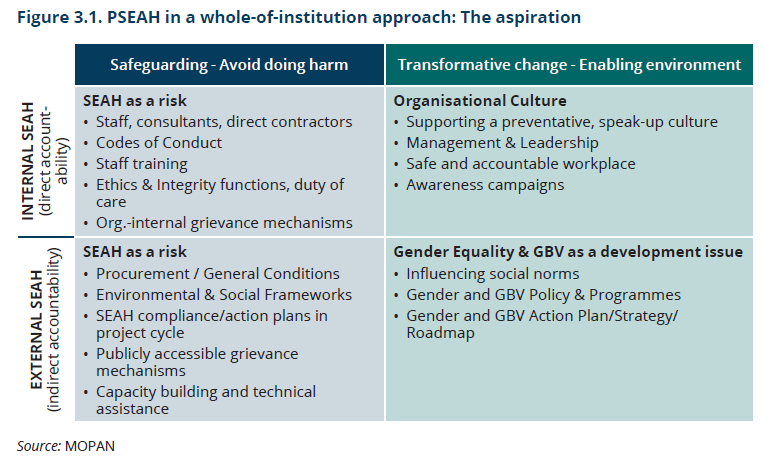
IFIs have strengthened their PSEAH architecture since 2018, but progress remains uneven. Most IFIs have improved their internal ethics and misconduct systems, updated their E&S frameworks and expanded guidance on GBV/SEAH externally. Yet evidence shows that measures differ widely in scope, clarity and enforceability.
Few IFIs have whole-of-institution PSEAH strategies or policies that define expectations for staff and partners and provide coherence. MOPAN assessments indicate that most IFIs have no board-approved, organisation-wide strategy to date. Rather, they often address SEAH in a fragmented way. Measures are dispersed in multiple policy documents without any unifying framework for consistent practice across portfolios. Institutional expectations are unclear and senior-level signalling is weakened as a result.
Without unified institutional frameworks, IFIs risk fragmented implementation, variable leadership signals and limited integration of SEAH in country-level dialogue. MOPAN finds that SEAH considerations seldom appear in high-level country strategies. Most IFIs lack an overarching institutional vision to anchor upstream engagement; SEAH thus appears primarily through compliance mechanisms at project level rather than as part of a coherent strategic agenda.
IFAD has the only dedicated, mandatory, institution-wide, board-approved PSEAH instrument of the seven IFIs assessed (IFAD, 2018[15]). It overarches the organisation’s SECAP – its E&S framework -- which also integrates PSEAH comprehensively by making requirements explicit in Standards 5 and 6. IFAD recognises the important connection between PSEAH as a risk management issue and the broader institutional commitments to gender equality and sustainable development (Box 3.1). AfDB also has an institution-wide PSEAH directive, but it is neither board-approved nor publicly available. All other IFIs lack a whole-of institution strategy. In contrast, such overarching policies are common practice in UN institutions and exist in vertical funds such as the Global Fund and Gavi.
In ADB, AfDB, EBRD, and IDB, the highest-level commitment to PSEAH is enshrined in the E&S policy and translated into E&S standards. No mention of PSEAH is made in the World Bank and IFC’s E&S policy and standards. The highest-level commitment to PSEAH is in the practice notes and guidance notes for borrowers on relevant E&S standards (see Section 4.1). To compensate for this policy gap, the World Bank and IFC have integrated mandatory requirements in legal agreements with clients and in WB standard bidding documents and internal processes driving WB and IFC due diligence Figure 3.2 shows where IFIs integrate PSEAH provisions in their broader risk architectures. Section 4.1 explores this in more detail.
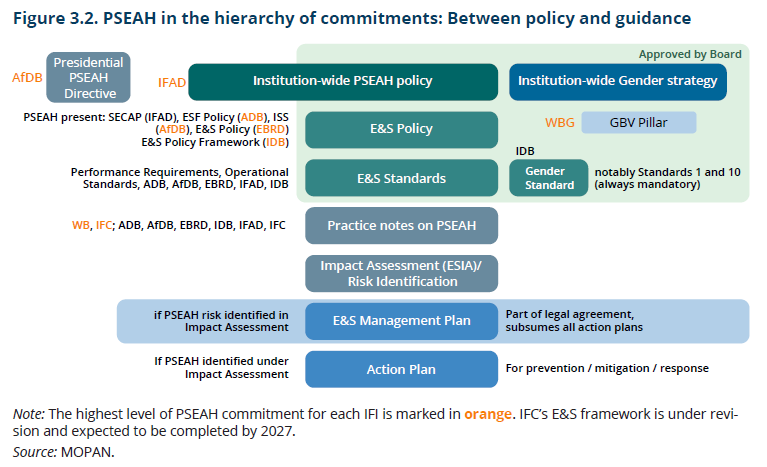
Policy benchmarking has shaped recent framework revisions, but IFIs still diverge substantially. ADB, EBRD and IFC have compared their frameworks with those of peer institutions during their E&S framework revisions, which has helped them refine their approaches. Yet even with this cross‑institution learning, they continue to differ in how explicitly they address SEAH, their scope of application,15 and in how firmly they enforce related requirements. PSEAH provisions cascade from the policy level to implementation through risk frameworks, standards, and practice notes. Where PSEAH is integrated into standards (ADB, AfDB, EBRD, IFAD, IDB), obligations are mandatory. Where PSEAH appears only in guidance (World Bank, IFC), uptake - though supported through legal agreements with clients, standard bidding documents and mandatory internal processes - depends heavily on staff interpretation and institutional culture.
A whole-of-institution approach requires a gender policy that clearly addresses GBV (and SEAH as part of it). Unlike other IFIs, the World Bank Group included a dedicated GBV Pillar in its updated 2024 strategy, which is aspirational but not binding. Nonetheless, the pillar reflects the institution’s commitment (expressed in its ESF Vision) to go beyond “do no harm” to actively maximise development gains. ADB has anchored PSEAH in its gender operational plan. Such linkages between gender, GBV and SEAH policies signal a shift towards seeking long-term, systemic outcomes by supporting client countries to strengthen prevention, response and redress mechanisms. Interviewees from IFIs have said that anchoring PSEAH in the gender policy or strategy also creates additional scope for audits and evaluations, thereby enabling deeper reflection, learning, and follow-up.
A whole-of-institution approach further requires linking internal and external PSEAH responsibilities. Most IFIs do not make the link explicit between the responsibility for harm created by their staff, and the shared responsibility with clients in operations. Internal SEAH is governed by internal ethics systems, HR systems and CoCs, while external SEAH is managed separately through E&S frameworks, legal covenants and borrower responsibilities. IFAD is the only IFI whose PSEAH framework explicitly unifies both, increasing strategic coherence.
The growing body of GPNs and technical guidance supports implementation but cannot substitute for binding policies or standards. IFIs have produced extensive GPNs and guidance on child safeguarding, private sector operations, corporate boards, civil works, labour influx, human development sectors, GMs and workplace conduct. Some of these have resulted from collaboration among several IFIs.16 Although these tools enhance operational consistency, they remain voluntary in most institutions. In the World Bank, for example, GPNs are considered authoritative interpretations of the ESF but are not themselves mandatory. Guidance cannot ensure consistent uptake across portfolios unless it is formally integrated into standards.
Box 3.1. IFAD’s unique PSEAH policy framework
An overarching PSEAH policy since 2018
IFAD’s PSEAH framework is unique among the IFIs. Its comprehensive 2018 Policy to Preventing and Responding to Sexual Harassment, Sexual Exploitation and Abuse formalises expectations and procedures, and strengthens transparency, accountability, and consistency over time beyond informal norms or organisational culture. It sets standalone rules for all IFAD operations and personnel, regardless of grade or contract type, applying to vendors, suppliers and other contracted third parties.
With its zero-tolerance standard for SEAH, the policy establishes clear requirements for prevention and prompt, effective response to allegations. It specifies conduct and reporting obligations, roles and responsibilities for reporting mechanisms, confidentiality and investigation procedures and disciplinary measures. It also requires preventive and monitoring actions – communication, background checks, mandatory training, SEAH risk assessment in project design, and support to affected persons.
Several Standards in IFAD’s Risk Assessment Procedures speak to PSEAH
In 2021, IFAD complemented its 2018 policy with updated Social, Environmental and Climate Assessment Procedures (SECAP) and corresponding guidance. SECAP establishes addressing GBV and discrimination, including SEAH, as a guiding principle and specific requirement in all IFAD projects. It incorporates provisions in standards 5 (labour and working conditions) and 6 (community health, safety and security). Procedures note that “SECAP goes beyond avoiding risks […] to identify opportunities for maximising development gains by mainstreaming environmental, social and climate issues throughout the project cycle” (IFAD, 2021c[16]).
Raising the profile of PSEAH in IFAD
IFAD is developing a new PSEAH policy that will supersede and amend earlier internal policies and contractual documents, including parts of the SECAP framework. It plans to submit it to its board and to the IFAD Audit Committee in 2026. It expects the new policy to become one of its highest-ranking policies, with PSEAH obligations for IFAD and government partners cascading to other documents. This leadership-level commitment is a good practice, needed to make PSEAH protections overreaching beyond high-risk projects.
Sources: IFAD (2018[15]), Policy to preventing and responding to sexual harassment, sexual exploitation and abuse, https://www.ifad.org/documents/d/new-ifad.org/sea_e_web-pdf; IFAD (2021c[16]), Social, Environmental and Climate Assessment Procedures Volume 1, https://www.ifad.org/documents/d/new-ifad.org/secap2021_01-pdf: and MOPAN interviews and email exchanges with IFAD staff between June and November 2025.
References
15.
For instance, while the IFC’s Performance Standards and AfDB’s ISS applies to all types of operations, including technical assistance, the IBRD’s E&S framework applies only to investment project financing, but not to development policy financing, program-for-results, or others.
↩
16.
EBRD and IFC are jointly developing a guidance note on financial intermediaries . Other joint notes have been elaborated by EBRD with ADB.
↩