Project-related SEAH sits at the centre of IFIs’ operational responsibilities. All institutions now treat it as a core risk that can undermine development outcomes, community trust and the integrity of financing (Section 2.2). Accountability for SEAH in operations rests primarily with borrowers and clients once financing agreements are signed. The role of the IFIs is to have their E&S systems, legal agreements and oversight functions identify, mitigate and supervise risks. The evidence shows meaningful progress across institutions, though depth and enforceability differ considerably.
PSEAH in IFIs: Progress, Gaps and the Road Ahead

External misconduct: SEAH in Operations
PSEAH embedded in environmental and social frameworks
IFIs have used E&S frameworks as the primary vehicle for integrating PSEAH into operational risk management. Most have revised their E&S frameworks between 2021 and 2024 to expand coverage of GBV and SEAH risks in line with increased global attention to this agenda — ADB, AfDB, EBRD, IDB and IFAD. IFC is currently revising its E&S framework; the public consultation phase ends in FY28.17
PSEAH provisions differ among IFIs in how explicit and strong they are. The language on SEAH reflects these differences. AfDB “commits to protecting” from SEAH; EBRD, as part of its commitments, “prohibits” all forms of SEAH; IDB requires borrowers to address SEAH risks; IFAD requires borrowers/recipients/partners to adopt measures to prevent and address SEAH, and ADB seeks to “protect project worker and community health, safety, and security, including from any forms of SEAH.”
IFIs are building PSEAH directly into binding E&S standards increasingly, which strengthens enforceability and makes SEAH mitigation as important as other mandatory risk management measures. Some E&S standards explicitly address SEAH risk (ADB, AfDB, EBRD, IFAD, IDB)18 while others cover areas indirectly influencing it (Table 4.1)
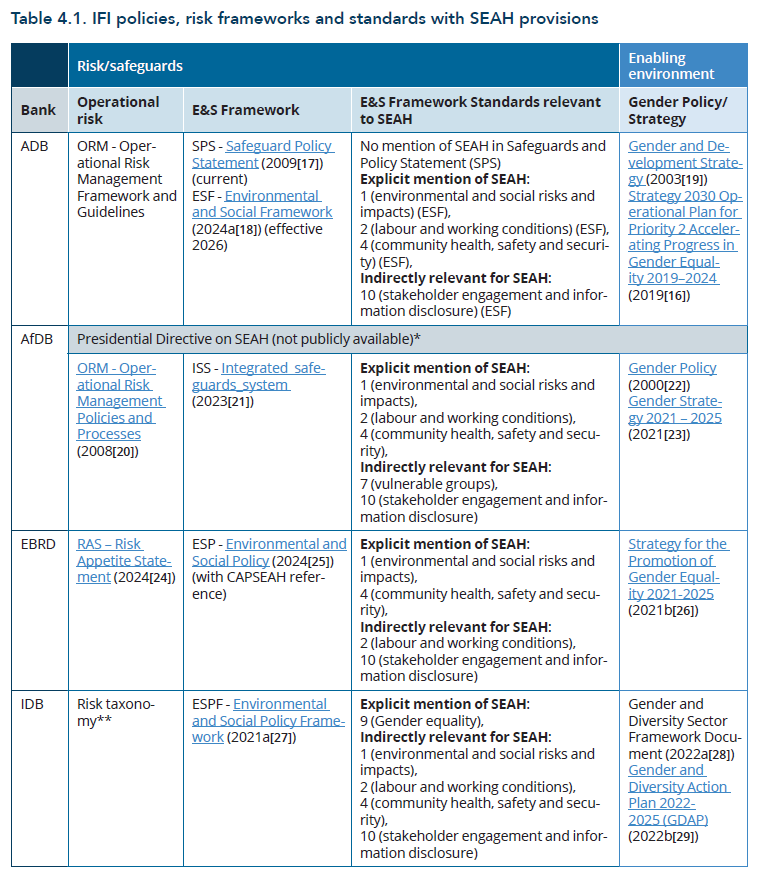
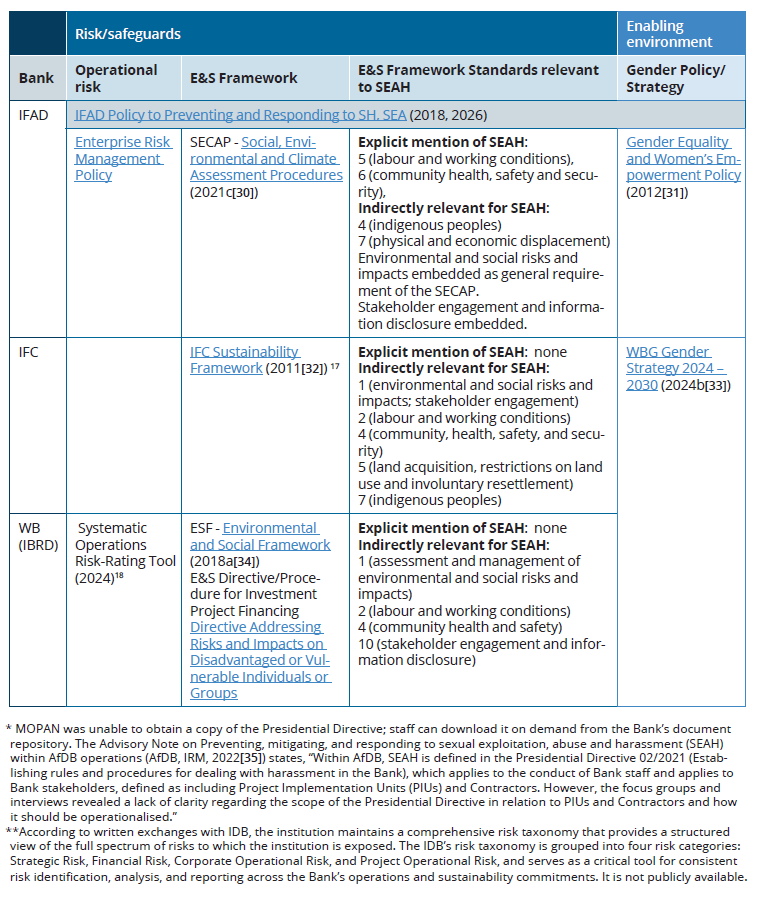
IDB stands out for its dedicated gender standard, which incorporates GBV/SEAH prevention as a core safeguard requirement within the ESPF framework (IDB, 2021[29]; IDB, 2022a[30]) (Box 4.1). It requires borrowers to adopt gender-sensitive consultations, inclusive employment measures and survivor-centred grievance mechanisms (IDB, 2021a[29]; IDB, 2022a[30]).
Box 4.1. How IDB’s gender standard ensures uptake of SGBV in its operations
IDB is the only IFI with a standalone E&S standard on gender equality (Standard 9), which increases the visibility of PSEAH requirements and SEAH prevention as central to achieving gender equality outcomes.
Standard 9 sets out how gender-sensitive processes can be embedded in project design and execution, including CoC, consultations, employment and survivor-centred GMs to prevent gender-based discrimination and GBV. It also strengthens IDB’s institutional signalling by elevating gender equality and the prevention of SGBV, including SEAH, as a central safeguard rather than cross-cutting themes. This requires borrowers and executing agencies to align their internal systems and policies with IDB’s expectations, thereby reinforcing national gender governance.
The gender standard is anchored in the institution’s strategic direction for gender and diversity architecture, which includes operational plans, the gender and diversity sector framework document and action plans that all guide and operationalise the mandates reflected in Standard 9.
A recent ADB study comparing gender safeguards across IFIs shows that it is also the most comprehensive safeguard coverage, with explicit gender considerations not only in the standalone gender standard, but also across several other standards (ADB, 2022[37]).
Source: IDB, (2022a[30]) Gender and Diversity Sector Framework Document, https://ezws.iadb.org/getdocument.aspx?docnum=EZSHARE-1011213690-92: IDB, (2021a[29]), Environmental and Social Policy Framework (ESPF), https://ezws.iadb.org/getdocument.aspx?docnum=EZIDB0000073-1327742410-167: IDB written communication with MOPAN, 10 November 2025
Not all E&S frameworks include explicit language on PSEAH, and the degree of obligation differs among institutions. EBRD, AfDB and ADB, which do not have a gender standard, embed SEAH-related provisions within other E&S standards (see Table 3.2). They address SEAH implicitly within broader labour, community safety or stakeholder engagement standards. Without an anchor in PSEAH requirements in the standards themselves, they rely on interpretation, guidance, financial agreements and procurement contracts to operationalise requirements.
Some IFI E&S frameworks make no reference to SEAH. The World Bank and IFC are the sole institutions in the sample with E&S frameworks (published in 2018 and 2012 respectively) that do not speak to it (see Table 4.1 and Table A.F.1, Annex F). Given that frameworks are ageing, they have relied only on guidance and GPNs for PSEAH. Requirements arise instead through interpretation of broader E&S standards such as WB ESS2, ESS4 or IFC Performance Standards, elaborated in non-mandatory GPNs and Guidance Notes for Borrowers and in legally binding clauses integrated in project-level legal agreements with clients, or in procurement contracts. This creates more variability in how SEAH is addressed, depending on staff expertise and borrower familiarity with the guidance. (See Annex F Table A.F.1 for a cross-institutional snapshot of the integration of SEAH risk prevention and mitigation across IFI E&S frameworks.)
GPNs and guidance notes provide more detailed guidance on how to mitigate the risks of SEAH and address its harms than language in policies, which is, by nature, succinct. That said, GPNs and guidance notes do not have the same weight if they are not simultaneously anchored in policy.
Translating standards into binding project-level instruments
Binding policy instruments
IFIs use binding project instruments to turn standards into borrower commitments. These instruments differ slightly across IFIs but typically involve E&S management plans or their equivalent (ESAPs and ESCPs). Some IFIs make these measures enforceable by attaching legal covenants to lending agreements that make it binding upon partners to fulfil the ESMP.21 These plans specify activities such as CoCs, training, community engagement, grievance mechanisms and monitoring arrangements. Conversely, IFIs commit to monitor their portfolio and conduct supervision missions during implementation to check client compliance in implementing E&S management plans.
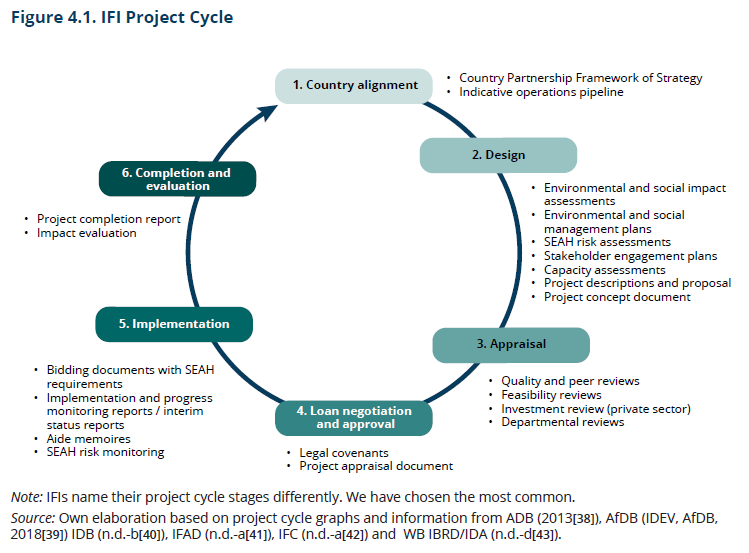
Figure 4.1 illustrates how PSEAH requirements typically enter and progress throughout the project cycle. As IFIs put their commitments to PSEAH into practice in projects, they have opportunities to address SEAH in different phases of the cycle. Annex C provides a detailed description of how SEAH is addressed in each phase of the project cycle. For simplicity, this description focuses on sovereign loans.
Guidance and Good Practice
IFIs have developed an expanding body of guidance to operationalise PSEAH requirements. Over time, the range of guidance and GPNs has expanded from covering major civil works and other projects likely to lead to a large labour influx to manufacturing, public transport, tourism, agribusiness and the private sector generally. Most recently, they have begun to focus on child safeguarding22, social and human development projects such as health and nutrition, social protection, and education, in situations where businesses, civil servants and other project implementers have daily contact with vulnerable populations. They also cover GMs and workplace conduct. The GPNs target two different audiences: borrowers and clients and IFI personnel (Table 4.2).
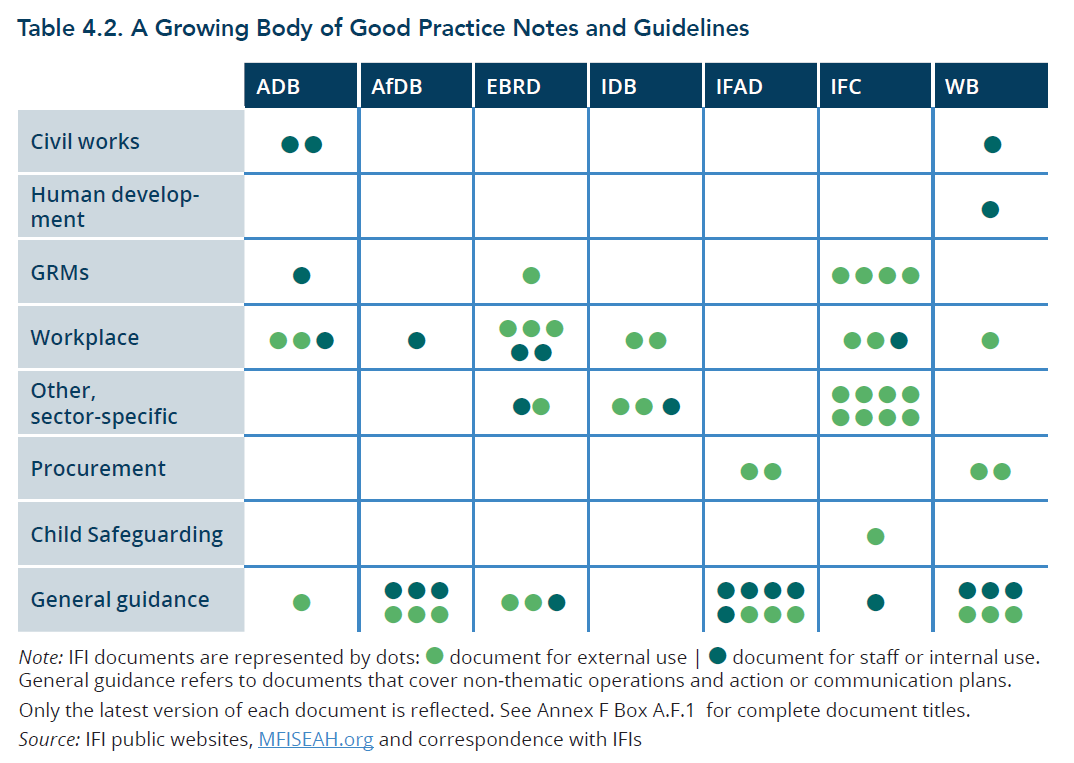
These guidance materials strengthen practice but remain largely advisory in most IFIs, creating uneven uptake. At the World Bank, although they are not binding, they are understood as a translation of the mandatory policies from the ESF into more detailed guidance for implementation. However, unless good practice is systematically integrated into E&S frameworks, the negotiation of the integration of specific PSEAH measures into binding commitments and plans is left to project-level dialogue with borrowers.
The result is a gap between the minimum practices required in E&S frameworks and performance standards and good practice described in the non-compulsory notes. E&S frameworks should be regularly updated to align with good practice. Some IFIs have updated theirs recently while others have yet to do so (Box 4.2).
Box 4.2. IFC’s inroads on Child Safeguarding through a new good practice note
Children have specific rights to protection and are one of the most vulnerable groups to SEAH risk. JIU, in its 2025 report on SEA in the UN system, found that between 2017-25, children accounted for 26% of victims affected by SEA. Their developmental capacity, needs, dependence, limited agency, and reduced access to reporting mechanisms make them susceptible to multiple forms of harm within operations, which makes comprehensive safeguarding provisions particularly crucial.
IFIs include child protection in their E&S frameworks, but focus on preventing child labour, hasardous work and trafficking in operations and supply-chain settings. In 2025 IFC became the first IFI to release a good practice note on Child Safeguarding in the Private Sector (2025c[44]). This constituted a new step in the expanding frontier of guidance that advances deeper into social aspects. The note advises businesses on how to align their operations with the IFC E&S Framework and international standards for children’s rights and child safeguarding to ensure robust protection and ethical practices. It calls for prevention and mitigation measures, including clear codes of conduct, recruitment and vetting practices, training of staff, safe operating procedures, and supervision of activities with child exposure.
IFC has committed to adding specific provisions on child protection and GBV to its updated sustainability framework.
Source: Written correspondence with IFC contacts, IFC (2025c[44]), Addressing Child Safeguarding in the Private Sector, https://www.ifc.org/en/insights-reports/2025/addressing-child-safeguarding-in-the-private-sector, and JIU, (2025[45]), Review of policies and practices to prevent and respond to sexual exploitation and abuse in the United Nations system organizations, United Nations, https://www.unjiu.org/news/review-policies-and-practices-prevent-and-respond-sexual-exploitation-and-abuse-united-nations.
Grievance Mechanisms
All IFIs embed GM requirements in their E&S Frameworks, including for SEAH. They typically do so through standards on managing E&S risks (often Standard 1), labour and working conditions (often Standard 2), community health and safety (often Standard 4), and stakeholder engagement and disclosure (often Standard 10).
A three-entry-point model for receiving grievances is common across IFIs (Figure 4.2):
Project-level GMs are established by implementing entities. They are also required for private sector lending. IFC stresses companies’ duty of care to maintain effective mechanisms, ensure rapid SEAH response, and link survivors to appropriate services. Borrowers are expected to report incidents and resolution to IFIs.23 Institutional complaints systems receive complaints directly at IFI level. They link to E&S safeguards systems and go beyond a single project. All IFIs have some form of these (for example, the World Bank’s Grievance Redress Service, IFAD’s SECAP redress service).24
- Independent accountability mechanisms provide an independent complaints mechanism at the institutional level for people who believe they have been harmed or whose issues remain unresolved (for example, IFC’s Compliance Advisor Ombudsman or IDB’s Independent Consultation and Investigation Mechanism). These mechanisms are independent from the institution’s management and staff and report directly to the Board.
Annex B element 4.7.3 provides an overview of resources and processes in place.
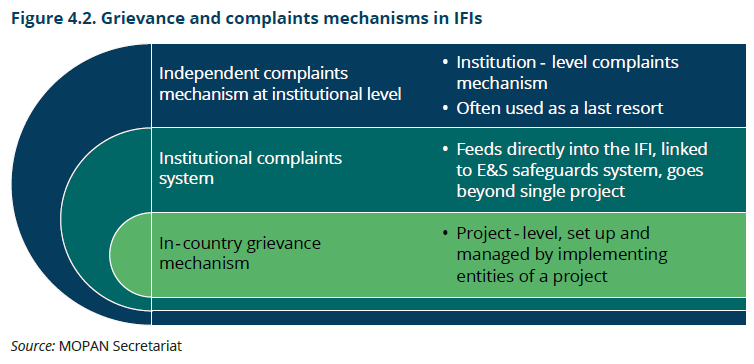
Project-level and institutional complaints mechanisms are intended to be accessible and responsive. The project GM is the most immediate channel for affected communities. IFIs generally encourage complainants to use local GMs or institutional systems before approaching the IAMs. Several IFIs formalise this sequencing: ADB requires complainants to raise concerns with the Bank before using the IAM as a ‘last resort’; the World Bank requires that issues be raised with management before a request for inspection is eligible, prior to approaching the IAM.
IFIs expect borrowers and contractors to ensure appropriate mechanisms are available for all individuals involved in or affected by a project. Where third parties cannot provide a GM, borrowers must extend their own. Some IFIs (AfDB, IDB, IFAD, World Bank) encourage stand-alone systems run by GBV service providers in certain contexts. The World Bank Good Practice Note on SEA/SH in Civil Works (2022a[46]) and the ADB’s Good Practice Note for Civil Works (ADB, 2023c[47]) recommend such arrangements for projects with a substantial or high risk.
GM design principles are broadly aligned across IFIs. They require GMs to be proportional to project risks, culturally appropriate, transparent, and accessible without cost or retaliation, and early disclosure during project preparation. Clients must communicate procedures clearly and in locally relevant languages. EBRD and AfDB require child- and gender-sensitive case handling in addition.25 Despite convergent designs, GM practice still requires significant improvement.
Beyond projects: From project to country level influence
The project-by-project approach is powerful. Yet, as one interviewee put it, “you cannot use a single project to resolve national issues”. PSEAH is not only a project risk, but also part of the larger issues of GBV as a development challenge. Several IFIs therefore complement E&S safeguards at a sovereign level with programmatic, country level support, guided by gender policies and country strategies that treat GBV as a barrier to development outcomes. They resource this primarily through their financing portfolios or dedicated, instrument-linked grant windows. Those require national ownership, supported by portfolio-wide or country-level engagement to reduce GBV and strengthen systems to prevent and respond to SEAH.
IFIs have therefore begun to work increasingly to strengthen the context (“enabling environment”) for preventing and responding to SEAH in borrowing countries. Recognising that weak policy, legal, and service systems create barriers to development and undermine victim-centred approaches, several IFIs are pursuing a two-pronged approach. IFAD’s SECAP Procedures and the World Bank’s ESF vision call it “going beyond ‘do no harm’/risk-based approaches towards maximising development gains”. An example of such efforts, the World Bank’s overview assessments support governments to strengthen their E&S norms so that World Bank projects can one day rely on the country’s own systems (Box 4.3).
Box 4.3. Beyond project-based approaches to risk management: the World Bank in Nepal
The World Bank’s ESF Overview Assessments
Recognising that environmental and social regulations and practices are key to countries’ development and to project management, the World Bank assists countries in strengthening their systems, including for PSEAH. Its E&S policy allows it to undertake an “overview assessment of the Borrower’s existing policy, legal and institutional framework for addressing environmental and social risks and impacts, and related implementation capacity” (WB, 2018a, p. 29[35]) at a borrower’s request. The World Bank has completed or initiated more than 80 such assessments worldwide, several of which cover PSEAH aspects, including in the Dominican Republic26, Brazil, Mongolia and Nepal, and Cabo Verde.
Nepal’s environmental and social regulations unpacked
In 2022-23, the World Bank undertook an overview assessment of Nepal’s E&S risk management framework, analysing it in relation to its E&S framework. The goal was to identify opportunities to use the Borrower E&S framework where materially consistent with the ESSs, and to identify gaps between Nepal’s frameworks and selected World Bank E&S Standards. Ultimately the objective was to support a gradual move towards using the borrower’s E&S framework. The assessment went beyond a project-based approach to risk management with a view towards longer-term, systemic change.
Strengthening Nepal’s legislation on GBV and SEAH
SEA/SH was identified as a key gap. Nepal’s legislation did “not contain provisions to address project impacts and conditions that may exacerbate human security and safety issues, such as the risk of gender-based violence (GBV), especially […] SEA/SH.” The assessment recommended amending the environmental protection rules 2020 to require enhanced risk and impact assessment over the lifecycle of a project, with specific GBV and SEA/SH criteria.” Nepal’s EPR 2020 is currently being amended to cover gaps in PSEAH identified by the overview assessment.
From recommendations to guidance and capacity
In a similar effort, World Bank, ADB and IFC are supporting Nepal’s Ministry of Forests and Environment in preparing guidelines for conducting the Strategic Environmental and Social Assessment Report (SESA), a requirement of Nepal’s 2019 Environmental Protection Act. Both the guideline and the SESA will capture social aspects including SEA/SH. Through technical assistance to build capacity for the ESF, the World Bank plans to develop social impact guidelines based on national laws and systems that will also include SEA/SH.
Source: World Bank (2024d[48]), Nepal Environmental and Social Framework Overview Assessment Snapshot Report, https://thedocs.worldbank.org/en/doc/5694d80f7ca36f93d16ea89c211e2b77-0310012024/nepal-environmental-and-social-framework-overview-assessment-framework; and correspondence with the World Bank (November 2025)
Anchoring SEAH in gender strategies helps resource the PSEAH commitment. IFI staff report that embedding SEAH (as part of wider GBV) in gender strategies helps broaden the approach beyond safeguarding, position activities for transformational impact, and anchor resourcing. Yet not all gender strategies mention SEAH. The AfDB, EBRD and WBG do so and ADB does so in its Gender Operational Plan (ADB, 2019[18]). The World Bank prioritises GBV as a core pillar of its gender strategy and reflects GBV priorities as relevant in country partnership frameworks.27 Staff noted the World Bank’s GBV Action Plan28 in direct response to its 2016 SEAH investigation into the Uganda transport sector development project was pivotal to acquiring GBV expertise for PSEAH. EBRD’s gender strategy frames GBVH as a barrier to women’s equal participation, to be addressed through client HR policies, GBVH risk management and policy dialogue to strengthen governments’ legal frameworks.29 EBRD sees the forthcoming revision of its gender strategy as a chance to secure funding (including for PSEAH), build capacity and strengthen leadership.
The following examples show how IFIs translate these broader commitments into practice:
- Bridging gaps at the community level through grants: Public sector IFIs complement lending with grant-based community projects, implemented either stand-alone or alongside operations, which are often catalytic for project-specific approaches. For example, the World Bank’s project for institutionalising a GBV response in Federal Nepal aims to strengthen GBV capacities in provinces where the bank already has projects. It is financed by a USD 4.6 million grant from the State and Peacebuilding Fund, a multi-donor trust fund managed by the World Bank, and implemented by Nepal’s Ministry of Women, Children and Senior Citizens (WBG, 2024d[48]).
- Allocating safeguards/compensation mechanisms or contingency funds to GBV services when needed. Some IFIs, like the World Bank, recommend that Borrowers earmark a small part of their budgets in higher-risk operations to fill any identified gap in existing service provision and recruit a GBV service provider to ensure that any survivors receive the necessary support.30 They also include procurement guidelines on paying the related costs on the contract, and verifications of the inclusion of mitigation actions.
Mobilising resources to strengthen the “enabling environment” for GBV prevention and response still remains a major challenge (Challenge 4: IFIs are not working through a “whole-of-institution” vision for PSEAH and Challenge 7: A shortage of PSEAH capacity and resources and the lack of capacity benchmarks result in prioritisation of only the highest-risk cases, leaving many projects underserved). The last of the 2018 commitments, to “support clients to develop and implement policies and mechanisms that address sexual harassment, abuse and exploitation” has therefore not been easy to implement.
Towards harmonised IFI practice
Operational co-operation
IFI country-level cooperation on GBV and PSEAH has expanded in recent years and is expected to intensify. Interviewees attribute this to the need to reduce the burden on borrowing governments (or on borrowing companies, in the case of multiple lenders to private sector projects). They also attribute it to the wider financial crisis in the aid sector that requires greater organisational efficiency. The strain on humanitarian services for survivors makes joint efforts to strengthen national and local systems especially critical. Closer cooperation also signals IFIs’ intent to strengthen their contribution to global public goods by supporting governments’ accountability towards their citizens.
More joined-up support to partner countries is possible, particularly where several IFIs work side by side, each concluding their own agreements with the government. Box 4.4 provides illustrations of emerging collaboration between IFIs on PSEAH.
Box 4.4. Emerging technical collaboration between IFIs on PSEAH
Emerging collaboration shows how IFIs enhance efficiencies and improve their joint knowledge by drawing on each other’s resources for service mapping, training, and statistics. Recent examples include:
Mapping services together: ADB and World Bank are currently working on a shared template to map existing GBV services, which is to be refined and disseminated in 2026.
Developing capacity jointly: Several IFIs – including World Bank, ADB, and EBRD – are exploring joint client training. The Multilateral Cooperation Center for Development Finance – a Chinese-initiated multilateral development finance mechanism administered by AIIB that is being developed to facilitate coordination of IFIs along the Belt and Road - has built a collaborative platform to bring together learning resources across IFIs, to help make capacity development more transparent and coordinated.
Standardising indicators: Although not specifically focused on PSEAH, work is underway in one MFI working groups to harmonise reporting metrics for health and safety, which could potentially encompass SEAH. Unifying these measures would allow recognising global trends.
Source: Interviews and written exchanges with IFIs for this study, June and November 2025
One step further, IFIs are also moving towards harmonised frameworks related to their risk approach that would enable them to take a unified approach to clients, develop synergies and further reduce fragmentation.
- The World Bank and AfDB are piloting joint sovereign borrower assessments in Central and West Africa that would allow IFIs to share overview assessments and rely on the same data – including on PSEAH/GBV – to strengthen country capacity. This could facilitate the use of sovereign project level borrower E&S frameworks even if it would not replace the need for project-level assessments.
- Mutual reliance frameworks are being tested. These would allow one IFI to rely on another’s due diligence in joint projects, effectively applying a single joint set of standards. The World Bank has signed one with ADB and is exploring the possibility of establishing similar frameworks with other IFIs. These frameworks hold promise for harmonising risk standards, thereby reducing fragmentation, improving efficiency and capacity building. In interviews, IFIs suggested they bring benefits such as reducing partner burden and increasing efficiencies in GBV service mapping and assessments. But institutions also noted that the harmonisation process itself can be burdensome, and CSOs have raised concerns about risks of lowering safeguard standards (Box 4.5).
Box 4.5. Mutual Reliance and Enhanced Cooperation Framework: EBRD and IFC
In April 2024, IFC and EBRD signed a Memorandum of Understanding establishing their intent to explore the scope and feasibility of mutual reliance on each other's policies, procedures, and reports when co-financing projects. The Mutual Reliance and Enhanced Cooperation Framework (MR Framework) aimed at improving client service and gaining efficiencies in investment processing by reducing duplication and streamlining processes. On a transaction-by-transaction basis, one institution is designated as the Lead and the other as the Follower. The Lead Institution coordinates all project assessments and acts as the main point of contact with the client; the Follower Institution leverages the Lead’s work to streamline its own review processes. Each institution retains full accountability for its investment decisions and must follow its internal governance accountability and decision-making procedures. For MR, the Lead Institution is responsible for comprehensive due diligence and will share due diligence findings with the Follower Institution.
Source: EBRD, IFC (2025[49]), Guidance for Operational Teams Processing Mutual Reliance and Enhanced Cooperation Projects.
Towards One IFI Policy?
IFI co-operation on PSEAH began at the normative level and is gradually extending to operations, as evidenced above. MOPAN assessments and interviews show that IFIs now share policies and guidance in multilateral fora, benchmark themselves against peers, and are developing joint guidance, as seen with ADB, EBRD and IFC. They participate in ten different MFI working groups; and consider the MFI SEAH working group31 a powerful platform for peer learning. Quarterly technical and biannual policy meetings at policy director level allow for exchange of guidance, alignment of practice, learning, and the gradual convergence of policies and systems.
Country-level co-operation remains constrained by the lack of unified standards. Tools, workplans or targets issued to date are mostly agency-specific rather than joint, and the MFI Working Group’s agendas and outcomes are not public. Its 2026 workplan is expected to address some gaps; this and be important next steps for harmonising practice and facilitating collaboration. Shared standards and convergence are also key foundations for scaling up IFI collaboration (see Chapter 5).
Beyond the broad and outdated 2018 commitment, IFIs have no harmonised PSEAH standards. Policies and practice vary and language is inconsistent across IFI E&S frameworks, which sometimes leads to confusion. Nonetheless convergence is advancing. This is visible in the MFI SEAH Working Group’s contribution, and in IFIs benchmarking themselves against their peers when undertaking policy revisions. EBRD reported benchmarking itself against EIB and IDB when updating its ESP in 2024. It is reviewing SEAH definitions in other IFIs in 2025-26 to promote alignment with them.32 In its current policy update, IFC is benchmarking itself against other MDBs and good industry standards such as those from ILO.
Interviewees cited CAPSEAH as an influential model. EBRD considers it a good framework to help companies and businesses incorporate sexual misconduct and has used it to design training. Several MFI group members consider that their policies already align to CAPSEAH, which is intended to be a universal framework for all types of organisations; it entails no legal obligations. While not formally endorsed by IFIs, it has been endorsed by over 230 organisations.33 Broad IFI endorsement of CAPSEAH, could therefore offer an early step towards shared standards.
The use of common standards would help borrowers and partner countries receive the same message from all institutions. This would be more powerful than distinct, IFI-specific policies. It would also allow for harmonising the language used around PSEAH and foster clarity about the expectations of the international community when funding public and private sector development projects through IFIs. Efforts to work towards a convergence of IFI policies would benefit from the leadership of the countries on IFI boards.
Some interviewees questioned whether a harmonised IFI policy should come first, but experts cautioned that negotiating a joint policy could be lengthy and slow other progress. IFIs and stakeholders should therefore rally around existing frameworks to the maximum extent possible.
References
17.
For further information about the update of IFC’s Sustainability Framework see https://www.ifc.org/en/what-we-do/sector-expertise/sustainability/policies-and-standards/update-of-ifc-s-sustainability-framework, accessed on 14 December 2025.
↩
19.
The IFC Sustainability Framework comprises the Policy on Environmental Sustainability , Performance Standards on Environmental and Social Sustainability , and Access to Information Policy
↩
20.
Systematic Operations Risk-Rating Tool is an internal document referenced in the Results and Performance of the World Bank Group 2024, Washington DC, 7 March 2025, Managing Results in an Uncertain World, IEG report of the World Bank IEG Results and Performance of the World Bank Group (accessible at https://ieg.worldbankgroup.org/evaluations/results-and-performance-world-bank-group-2024/chapter-2-world-bank
↩
21.
At the World Bank and the ADB, the E&S Management Plan is represented in legal agreements through the ESCP. World Bank ESCPs form part of loan agreements and include SEAH requirements where relevant. IFC and EBRD embed ESAPs in private-sector agreements. Since March 2025, IFC has additional SEAH-specific covenants in its loan agreements. ESMPs and other management plans used by ADB, AfDB, IDB and IFAD serve similar functions, ensuring SEAH risks are addressed in design, appraisal and supervision.
↩
22.
Apart from IFC’s child safeguarding good practice note, a World-Bank-financed note covers child safeguarding: Six Actions to Keep Children Safe around World Bank-Supported Projects: Recommendations to Address Child Sexual Exploitation and Abuse | CPC Learning Network
↩
23.
IFC , Toolkit to Support Firms to Develop and Manage Community-Based SEA/SH Grievance and Feedback Mechanisms, https://www.ifc.org/en/insights-reports/2022/publications-gender-grm-toolkit
↩
24.
Some IFIs permit complaints to be submitted directly to the institution without an apparent dedicated mechanism or named portal. For example, IFC allows complaints to be submitted online to its Environmental & Social team (“Submitting Environmental and Social Complaints to IFC”). The African Development Bank’s Integrated Safeguards System provides that project-affected people should first use the project-level GRM but “may also bring their concerns directly to the Bank’s attention,” after which the Bank will engage with the Borrower to address them. Similarly, the EBRD’s Environmental and Social Policy notes that, although clients must establish their own grievance mechanisms, the Bank “addresses concerns and complaints brought directly to its attention, while working with its clients on finding mutually agreeable solutions.”
↩
25.
EBRD ESP requirement 10 on stakeholder engagement: “The grievance mechanism will be gender inclusive and responsive and will include tailored arrangements for stakeholders with specific needs, including vulnerable people. The grievance mechanism will include dedicated reporting channels, trained personnel, specialist support and response procedures for certain complaints, such as those relating to gender-based violence, child sexual abuse and exploitation (including child-sensitive reporting mechanisms), and harassment or retaliation.” AfDB ISS Annex 1 of Operational Safeguard 10, “Where the risk of sexual exploitation, abuse and harassment (SEAH) or gender-based violence (GBV, child labour or modern slavery has been identified and/or a related complaint has been filed/registered, the grievance redress mechanism (GRM) shall include relevant technical expertise and remedial provisions.”
↩
26.
WBG, (2025b[110]), República Dominicana - Evaluación General del Marco Legal, Institucional, y de Políticas para la Gestión Ambiental y Social: Resumen (Spanish), http://documents.worldbank.org/curated/en/099500105212510670
↩
27.
WBG, Gender Strategy 2024 - 2030 Accelerate Gender Equality to End Poverty on a Liveable Planet, https://documents1.worldbank.org/curated/en/099061124182033630/pdf/BOSIB17e6952570c51b49812a89c05be6a4.pdf
↩
28.
WBG , Global gender-based violence task force: Action plan for implementation, https://documents1.worldbank.org/curated/en/206731510166266845/pdf/121031-WP-PUBLIC-Gender-Based-Violence-Task-Force-Action-Plan.pdf
↩
29.
EBRD , Strategy for the Promotion of Gender Equality 2021-2025, https://www.ebrd.com/content/dam/ebrd_dxp/assets/pdfs/gender---economic-inclusion/gender-equality/ebrd-promotion-of-gender-equality-2021-25.pdf
↩
30.
See WBG, Good Practice Note on addressing SEA/SH in IPF with Major Civil Works, https://thedocs.worldbank.org/en/doc/6f3d9ddc6010c4221315dd1282958e41-0290032022/original/SEA-SH-Civil-Works-GPN-Third-Edition-Final-October-12-2022.pdf , para 120 and Annex 5 and WB , Good Practice Note on Addressing SEA/SH in Human Development Operations, https://thedocs.worldbank.org/en/doc/e2ff01be0f07c82d73bc0c5e7ddf394f-0290032022/original/ESF-Good-Practice-Note-on-Addressing-SEA-SH-in-HD-Operations-First-Edition-September-16-2022.pdf, para 76
↩
32.
EBRD is comparing its definitions with those of ADB, AfDB, IDB, IMF and World Bank.
↩
33.
Full list available online on the CAPSEAH website.
↩