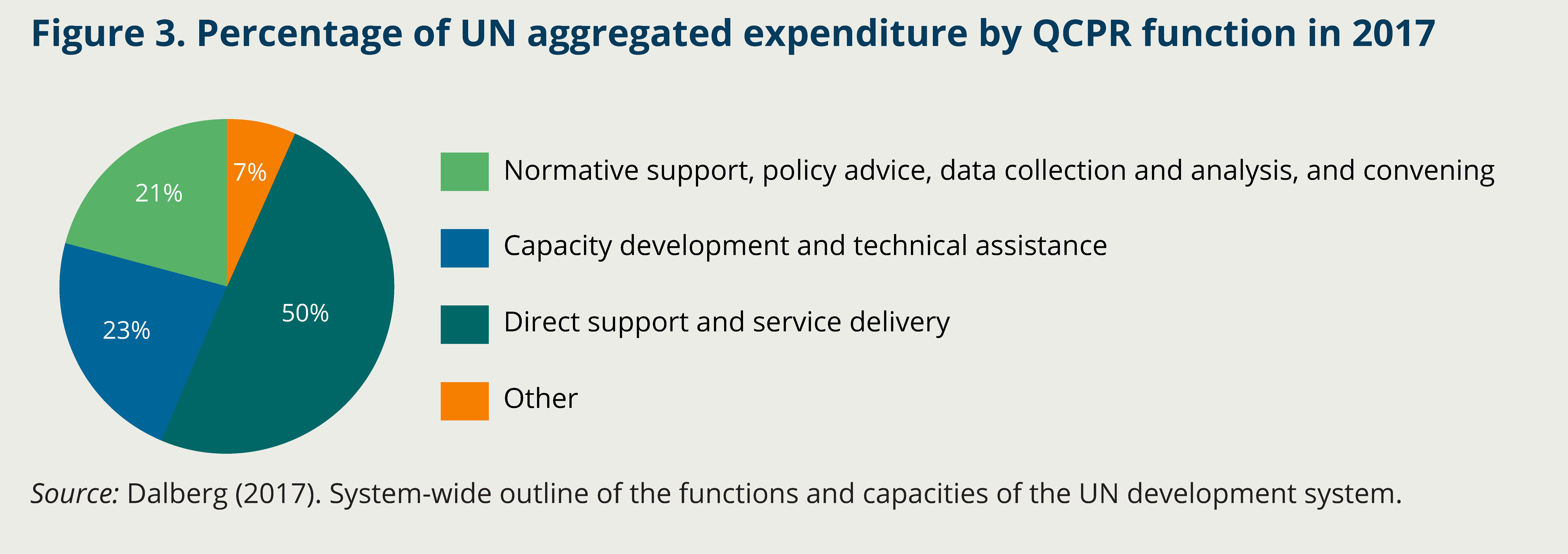
One of the central aims of the Secretary-General’s development system reform was to shift emphasis from direct service delivery toward integrated policy advice. A 2017 report of the Secretary-General stated that: “There is also a visible gap in the delivery of important functions required for the 2030 Agenda. The data revealed insufficient capacities for the provision of integrated policy advice. Providing integrated policy services is one of the main reasons why the United Nations development system has to do business differently. Strengthening the system’s capacity for policy advice will also be critical as governments increasingly request support in how best to integrate the Goals into their national plans and governance structures.”20 Both the 2020 and 2024 QCPR resolutions reinforced this objective.21
Eight years later, several reports indicate that the UN did not reach this objective. A 2022 study concluded that the UN development system’s prevailing operating model is not aligned with this vision of a coherent, high-level collective offer focused on strategic policy advice.22 In 2024, a consultancy report indicated that the proportion of UN expenditure allocated to policy advice had remained at around 5% since 2017. In 2025, the UN system-wide Evaluation Office released an evaluation of the new generation of UNCTs. It stated that since the shift towards policy advice aims to match UN capability to country needs, the new generation of UNCTs should help facilitate this shift. However, the configuration exercises, implemented to achieve a new generation of UNCTs, do not appear to have contributed to the shift from service delivery to integrated policy advice, even where there is demand.23