Sustainability is the weakest-performing dimension of results across MOPAN assessments and the only one to receive an unsatisfactory average rating. Among the 15 UN entities in the sample, seven were rated unsatisfactory or highly unsatisfactory, six satisfactory, and two were not rated due to insufficient data.
Closing the UN Mandate-Results Gap: Realigning Incentives for Lasting Impact
Effects: Reduced sustainability, inclusiveness and impact at scale
Sustainability of results
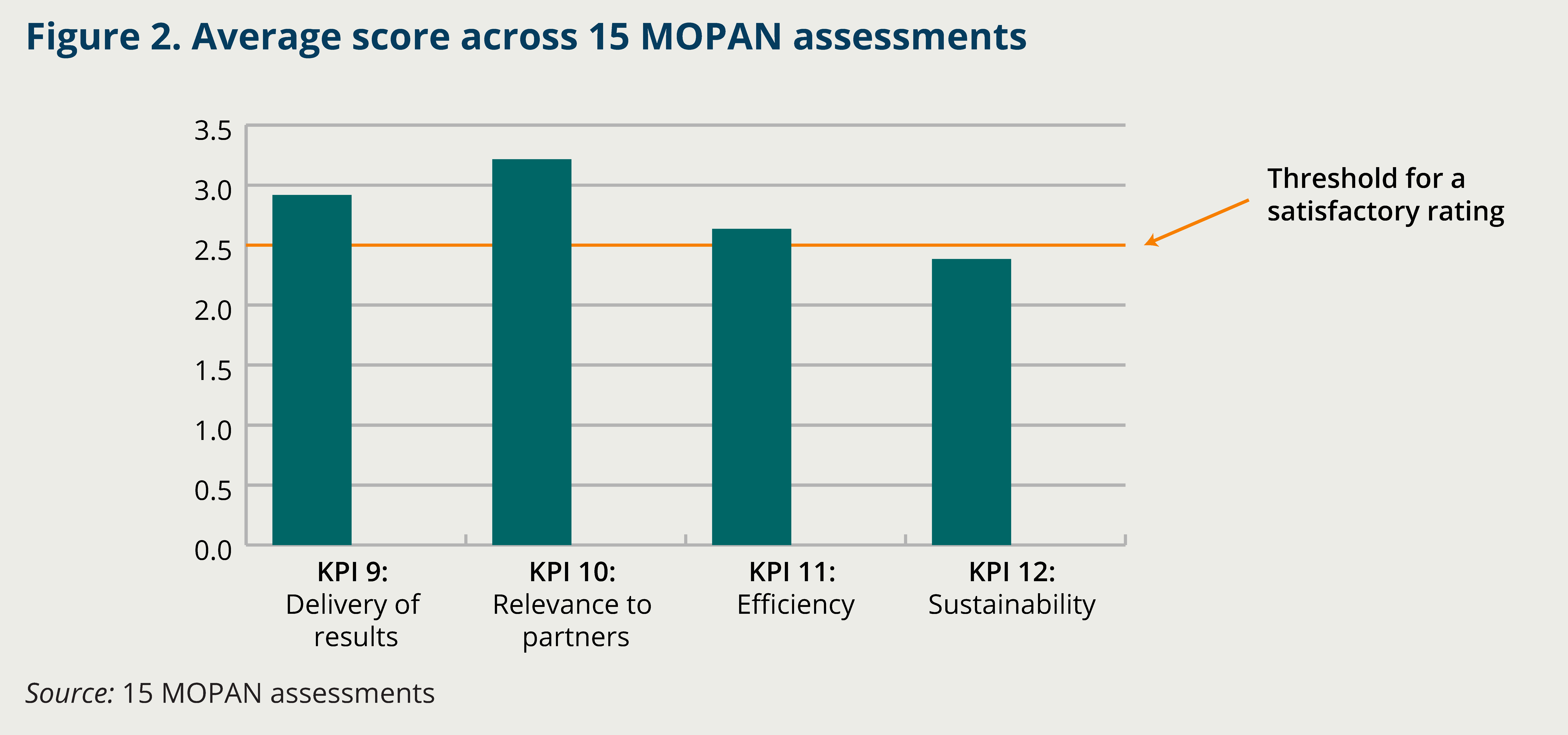
Lower sustainability scores are closely linked to the mix of functions deployed by UN entities. MOPAN’s 2021 assessment of UNDP, drawing on global, thematic, and country-level evaluations, found that interventions are more sustainable when they:
Connect upstream policymaking with downstream implementation partnerships
Establish structures and systems to better manage and co-ordinate interventions
Adopt an integrated, longer-term perspective with a clear exit strategy
Secure strong political commitment and viable financing models
Align with national policies and embed results within legal frameworks
Most of these enablers for sustainable results require UN development entities to deliver capacity development and policy advice at the country level. Operational interventions can be timely, relevant, and efficient without deep engagement with national systems and authorities. However, they cannot be sustainable without high-level engagement that shapes national priorities, strengthens political commitment, informs legislation and policy, and links upstream policymaking with downstream implementation partnerships.
The importance of combining these enablers was emphasised in a recent MOPAN assessment of UNFPA. The assessment found that while UNFPA’s efforts to strengthen local capacities and advocate for legal and policy reforms were promising, sustainability was undermined by partners’ financial dependence on the organisation and by the absence of clearly defined exit strategies.
Humanitarian entities such as UNHCR are also making efforts to strengthen the sustainability of results, particularly through the HDP nexus. However, the recent MOPAN assessment noted that while UNHCR recognises the importance of exit strategies that hand over responsibility to national governments and development actors, it has yet to develop a systematic approach to designing and following up on such strategies.
The link between sustainability and policy advice was also highlighted in a recent paper, which concluded: “Evaluations of the UN’s work at country level provide ample evidence of the shortcomings of interventions that are too much, or even exclusively, focused on implementation work while neglecting the policy dimension of development issues. Downstream interventions that do not address and resolve issues in national policies may still deliver quick and tangible results but will not address root causes and will have limited sustainable impact.”12
Inclusiveness of results
MOPAN’s assessment framework is aligned with the 2030 Agenda, which is built on an inclusive vision of development, anchored in international human rights standards, and places equality and non-discrimination at its core. In principle, this vision is operationalised through the UN’s Human Rights-Based Approach, the commitment to Leaving No One Behind, and the priority of Gender Equality and Women’s Empowerment. Humanitarian action likewise emphasises inclusiveness through the principles of humanity, neutrality, impartiality and independence, and is guided by frameworks such as the Core Humanitarian Standard and IASC policies that highlight gender, disability inclusion, and protection.
In practice, however, resources and incentives for mainstreaming these principles remain weak. UN entities such as OHCHR and UN Women have mandates to promote human rights and gender equality across the system, yet MOPAN’s 2025 assessment found that UN Women’s co-ordination role is constrained by limited incentive mechanisms for gender mainstreaming. More broadly, UN entities face persistent trade-offs between project delivery and engagement on normative issues. As Darrow and Arbour observed as early as 2009, the “business of development” (maintaining good relations with governments, completing projects on time, and securing funding) often runs counter to human rights demands.13 A decade later, a 2022 study by the German Development Institute confirmed that the tension remains unresolved, noting that programming documents highlight LNOB and human rights but lack clear strategies for collective UN engagement on these issues.14
System-wide planning guidance has not resolved trade-offs. A recent evaluation found that the strong emphasis on aligning with national priorities can discourage United Nations Country Teams (UNCTs) from addressing sensitive normative issues. Interviewees noted that it is not uncommon for governments to request that UNCTs omit text on certain human rights concerns.15 This underscores the persistent gap between the UN’s normative commitments to inclusiveness and the political and financial incentives that shape implementation at the country level.
Impact at scale
UN country programme evaluations frequently note that subnational interventions reach only a small segment of the population and rarely produce scalable and sustainable effects. Even successful projects often fail to demonstrate measurable contributions to national development.16 For projects to contribute meaningfully at the national level and to the SDGs, a systematic approach to scaling is required. This, in turn, depends on capacity development and policy advice to create enabling conditions such as viable funding models, policy reform, and institutional capacity.17
The 2025 MOPAN assessment of UN Women raised this concern, finding that the entity struggles to link its efforts to a measurable large-scale impact. Evaluation evidence also questions whether changes in legal frameworks, often central to UN Women’s work, are sufficient to deliver sustainable improvements for women and girls. More broadly, weakly articulated impact pathways in theories of change (ToCs) are among the most frequent shortcomings identified in UN country programme evaluations. This undermines policy focus in two ways: first, by reducing accountability and incentives for country offices to prioritise policy change; and second, by depriving them of a framework for sustained dialogue with senior policymakers, whose complementary actions are essential for impact.18
UNFPA illustrates both progress and remaining gaps. Its country offices are required to develop ToCs to formalise causal pathways. However, the 2025 MOPAN assessment noted that these causal pathways need to be further developed (as is the case in other UN agencies) to provide a discernible link between the outputs and the achievement of UNFPA’s outcome-level targets and the contribution to higher-level objectives. At the system-wide level, the challenge is even greater. UN Sustainable Development Cooperation Frameworks typically define broad outcomes, while Joint Work Plans list outputs without clear causal pathways showing how they contribute to those outcomes.19 This weakens accountability for mandate delivery across the UN system.
Humanitarian entities face similar challenges. MOPAN assessments of UNHCR, IOM and WFP all rated their use of ToCs in regional and country strategies as unsatisfactory. For example, while IOM’s Project Handbook provides some guidance on project-level ToCs, their inclusion in proposals is often driven more by donor requirements than by organisational practice. Across the system, the lack of robust ToCs and scaling strategies continues to limit the UN’s ability to demonstrate its contribution to national development and the SDGs.
References
12.
Hendra, J., & Baumann, M.-O. (2020), Towards more policy advice: Maximising the UN’s assets to build back better. Bonn: German Development Institute / Deutsches Institut für Entwicklungspolitik (DIE)
↩
13.
Darrow, M., & Arbour, L. (2009), “The pillar of glass: Human rights in the development operations of the United Nations,” The American Journal of International Law, 103(3), 446-501. DOI: 10.1017/S000293000001993X
↩
14.
Weinlich, S et al. (2022), New Rules, Same Practice? Analysing UN Development System Reform Effects at the Country Level, Discussion Paper, German Development Institute, Bonn. https://doi.org/10.23661/dp3.2022
↩
15.
United Nations System-wide Evaluation Office (UN SWEO) (2025), System-wide evaluation on progress towards a “new generation of United Nations Country Teams”.
↩
16.
Baumann, M.-O. (2022), “Policy advice in UN development work: High expectations and practical constraints”, Global Governance, 28, pp. 382–404.
↩
17.
Engberg, E. and J.F. Linn (2023), To reach the Sustainable Development Goals and global climate goals we have to scale up the impact of investments. Dag Hammarskjöld Foundation, Uppsala
↩
18.
Baumann, M.-O. (2022), “Policy advice in UN development work: High expectations and practical constraints”, Global Governance, 28, pp. 382–404.
↩