- The system is losing both programme coverage and institutional capacity, but the cumulative scale of the impact remains unclear.
- Sharper prioritisation is preserving selected priorities by narrowing coverage, reducing the intensity of support or scaling back enabling functions elsewhere.
- Capacity loss extends beyond frontline delivery to normative, policy, technical and knowledge functions.
- Comparative advantage is guiding organisation-level choices more explicitly, but not yet a system-wide division of labour.
Mapping of Multilateral Organisations' Response to the Current Funding Environment - 2026 Stocktake

Effects on delivery and institutional capacity
Key messages
The 2026 evidence provides a clearer picture of what “doing less with less” is beginning to mean in practice. Funding reductions are increasingly visible not only in lower expenditure or smaller workforces, but in the trade-offs organisations are facing about which activities to continue, who and where organisations can support, the amount and quality of support provided, and which technical and institutional functions can be sustained. These trade-offs are identified now more concretely. The evidence does not, however, provide a complete accounting of what has been lost: impacts are unevenly documented, some will emerge only over time, and activities that were never initiated or expanded are inherently more difficult to observe. The evidence is therefore strongest on direct reductions in coverage, staffing, technical support and programme scope, and weaker on unmet need, foregone expansion and cumulative system-wide capacity loss.
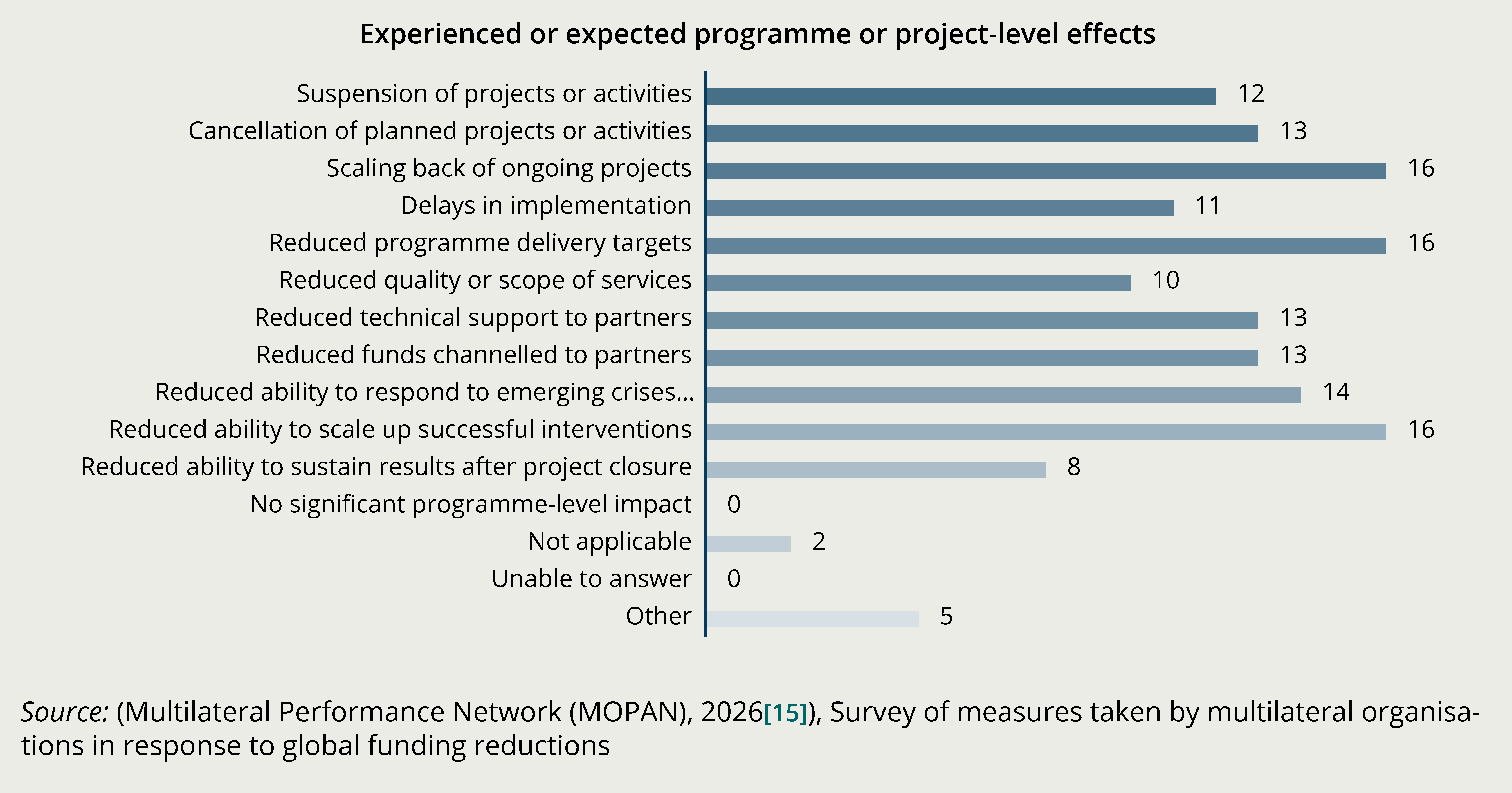
Twenty-three of 25 respondents reported at least one experienced or expected programme-level effect. The remaining two considered the question not applicable to them. No respondent selected “no significant programme-level impact”.
Sixteen respondents reported scaling back ongoing projects, 16 reduced programme-delivery targets and 16 reduced ability to scale successful interventions. Fourteen reported reduced ability to respond to emerging crises, while 13 reported cancellation of planned activities, 13 reduced technical support to partners and 13 reduced funding channelled to partners. Twelve reported project suspensions, 11 implementation delays and 10 reduced quality or scope of services.
Figure 10. Funding pressures are translating into widespread reductions in programme scale and delivery
Fragile and conflict-affected states and lower-income countries are the country categories most frequently identified by respondents as affected by funding reductions. Among the 13 survey respondents able to identify the types of countries most affected by funding reductions, 12 identified fragile and conflict-affected states, 11 low-income countries and 10 lower-middle-income countries. Only four identified upper-middle-income countries and one a high-income country (Figure 11). This broadly mirrors the pattern reported in the 2025 MOPAN Mapping.
Figure 11. Fragile and lower-income countries are most frequently identified as affected by funding reductions
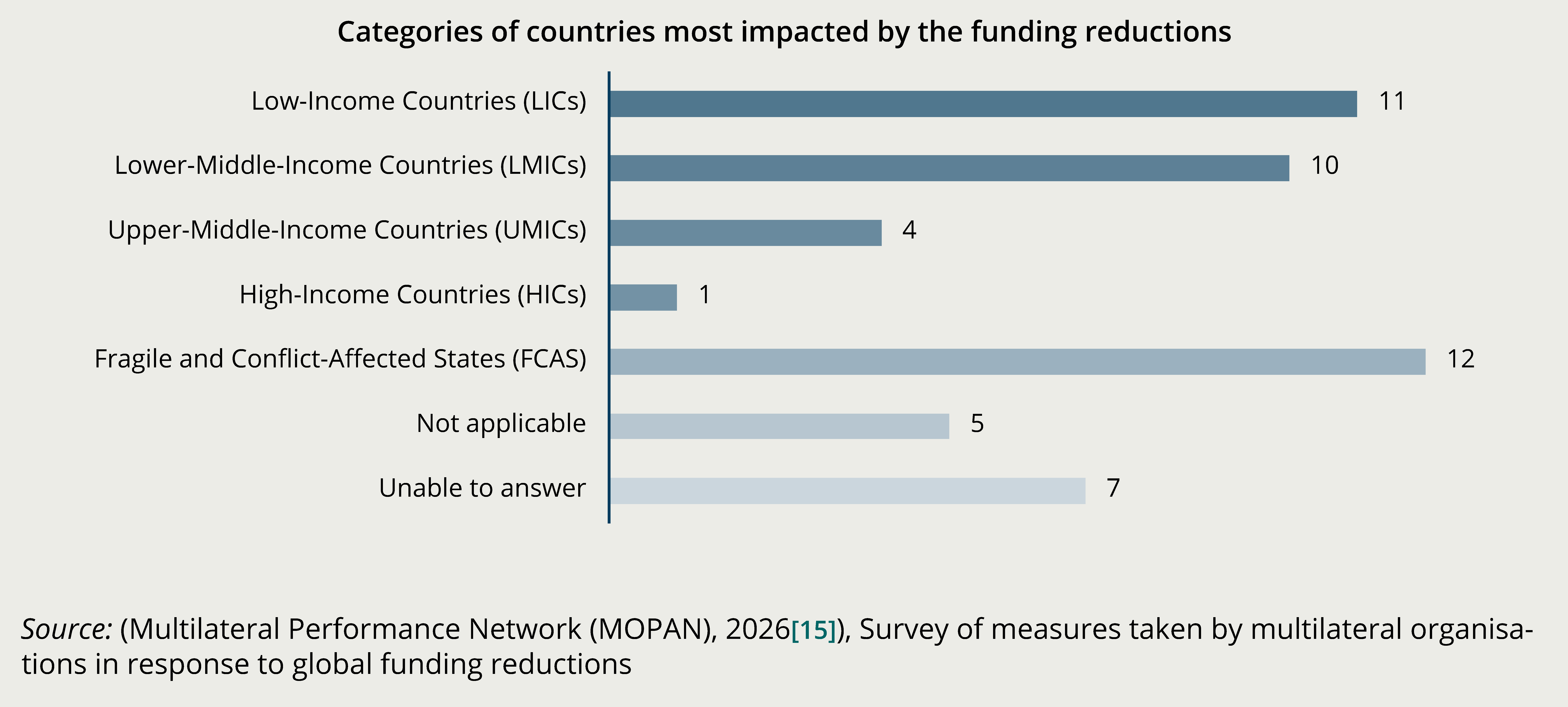
The result should be interpreted in the context of organisations’ mandates and portfolios: many organisations already concentrate a large share of their work in fragile and lower-income settings, so the survey does not establish that these countries are disproportionately affected relative to organisations’ existing exposure. It does, however, show that funding reductions are being felt in many of the contexts where needs are high, alternative financing is often more limited and multilateral organisations play substantial delivery, protection or technical-support roles.
Country-level evidence shows how these funding pressures are affecting delivery in high-need settings. WFP reported major reductions across operations including Afghanistan, the Democratic Republic of Congo, Somalia and Syria. In Somalia, emergency food-assistance coverage fell from 2.2 million people in early 2025 to just over 600,000 in February 2026; in Syria, emergency food assistance was halved from 1.3 million to 650,000 people and geographical coverage fell from 14 to seven governorates . UNFPA reported that funding reductions in Yemen left almost 1.5 million women without critical health services and 300,000 without gender-based violence services, alongside closures of health facilities, safe spaces and mobile teams ; severe underfunding also led to hyper-prioritisation of essential activities in the Central African Republic . UNHCR reported substantial reductions in protection and assistance in Afghanistan, South Sudan, Chad and Lebanon, while IOM reported that a USD 6 million funding gap threatened minimum water, sanitation and flood-protection services for around 187,000 people in South Sudan, in a context of large-scale displacement affecting nearly 1.9 million people
Funding pressures are resulting in sharper prioritisation but the trade-offs differ: some MOs are reducing the number of people, countries or projects supported; others are reducing the level, frequency or quality of support within existing coverage; and some are protecting core outputs by scaling back other activities or functions.
Some organisations are reducing coverage – the number of people, locations, projects or activities supported. For instance, WFP reports that Guinea-Bissau, school-meal coverage fell from 283 400 to around 152 000 children and specialised nutrition support for approximately 56 000 children was suspended. UNFPA’s evidence similarly shows closures of health facilities, safe spaces and mobile teams across several crisis settings. Gavi’s recalibrated 2026–30 programme has reduced or slowed planned vaccine introductions, measles and rubella activities, malaria-vaccine scale-up and health-system investments compared with its original ambition
Other organisations are maintaining broader coverage while reducing the amount, frequency or quality of support provided. WFP described this distinction explicitly:
“WFP protected its ‘reach’, reaching 121 million beneficiaries, but intensity and quality of assistance were severely impacted.” (MOPAN survey, 2026 – WFP)
WFP also reported that only 13% of in-kind food parcels met its nutritional-adequacy standard, against an annual target of 80%. (MOPAN survey, 2026 – WFP). UNRWA similarly, maintaining its presence, reduced service delivery by 20%, including shortening the school week from five to four days and clinic opening hours from 40 to 32 hours per week UNHCR shows a similar trade-off through cash assistance: the total cash disbursed fell by around 35%, from USD 650 million in 2024 to USD 424 million in 2025, while the number of recipients declined only slightly, resulting in lower levels of support per household. UNHCR reported that 71% of cash recipients could meet only half or less of their basic needs .
Similarly, WHO has maintained country support while concentrating intensive technical assistance in fragile and priority settings and relying on lighter-touch support elsewhere and OHCHR continued core investigative and Special Procedures work, but with several investigations operating at around half capacity and country visits reduced from two to one per year.
A third approach is to protect selected priorities by reducing, postponing or discontinuing other activities. The Global Fund’s 2025 reprioritisation reduced country allocations by approximately USD 1.43 billion, while donor payments and deferral of selected activities helped maintain essential HIV, tuberculosis and malaria treatment. Reductions were felt more heavily in prevention, training, supervision, technical assistance, oversight and systems-strengthening activities, and emerging gaps were reported in areas including malaria vector control, tuberculosis case-finding and HIV prevention (MOPAN Survey, 2026 – Global Fund) and for GEF a smaller replenishment envelope is translating primarily into tighter allocation choices and lower capacity to expand or scale future programming rather than immediate withdrawal from existing projects
The same approach is visible for WHO protecting core normative, policy and convening functions while reviewing technical products, assessments and deliverables for continuation, scaling down or discontinuation and making intensive country support more selective. UNESCO reported postponed, reduced or remotely delivered activities, including conferences, technical assistance, training, missions and policy-planning support, while continuing to deliver a high share of its planned outputs . FAO reported pressure on both technical and analytical capacity, including a contraction in the country coverage of its Data in Emergencies Monitoring system from a peak of 28 countries to 12, alongside constraints on technical assistance and emergency and resilience work (MOPAN Survey, 2026 – FAO)
These different forms of prioritisation also affect partners. Thirteen survey respondents reported reduced technical support to partners and 13 reduced funding to partners. In some cases, organisations are increasingly relying on governments, local organisations or other multilateral actors to sustain activities previously financed or supported directly. This can preserve elements of delivery, but the effect depends on whether responsibilities are accompanied by sufficient finance, technical capacity and time for transition.
“WFP protected its ‘reach’, reaching 121 million beneficiaries, but intensity and quality of assistance were severely impacted.” (MOPAN survey, 2026 – WFP)
WFP also reported that only 13% of in-kind food parcels met its nutritional-adequacy standard, against an annual target of 80%. (MOPAN survey, 2026 – WFP). UNRWA similarly, maintaining its presence, reduced service delivery by 20%, including shortening the school week from five to four days and clinic opening hours from 40 to 32 hours per week UNHCR shows a similar trade-off through cash assistance: the total cash disbursed fell by around 35%, from USD 650 million in 2024 to USD 424 million in 2025, while the number of recipients declined only slightly, resulting in lower levels of support per household. UNHCR reported that 71% of cash recipients could meet only half or less of their basic needs .
Similarly, WHO has maintained country support while concentrating intensive technical assistance in fragile and priority settings and relying on lighter-touch support elsewhere and OHCHR continued core investigative and Special Procedures work, but with several investigations operating at around half capacity and country visits reduced from two to one per year.
A third approach is to protect selected priorities by reducing, postponing or discontinuing other activities. The Global Fund’s 2025 reprioritisation reduced country allocations by approximately USD 1.43 billion, while donor payments and deferral of selected activities helped maintain essential HIV, tuberculosis and malaria treatment. Reductions were felt more heavily in prevention, training, supervision, technical assistance, oversight and systems-strengthening activities, and emerging gaps were reported in areas including malaria vector control, tuberculosis case-finding and HIV prevention (MOPAN Survey, 2026 – Global Fund) and for GEF a smaller replenishment envelope is translating primarily into tighter allocation choices and lower capacity to expand or scale future programming rather than immediate withdrawal from existing projects
The same approach is visible for WHO protecting core normative, policy and convening functions while reviewing technical products, assessments and deliverables for continuation, scaling down or discontinuation and making intensive country support more selective. UNESCO reported postponed, reduced or remotely delivered activities, including conferences, technical assistance, training, missions and policy-planning support, while continuing to deliver a high share of its planned outputs. FAO reported pressure on both technical and analytical capacity, including a contraction in the country coverage of its Data in Emergencies Monitoring system from a peak of 28 countries to 12, alongside constraints on technical assistance and emergency and resilience work (MOPAN Survey, 2026 – FAO)
These different forms of prioritisation also affect partners. Thirteen survey respondents reported reduced technical support to partners and 13 reduced funding to partners. In some cases, organisations are increasingly relying on governments, local organisations or other multilateral actors to sustain activities previously financed or supported directly. This can preserve elements of delivery, but the effect depends on whether responsibilities are accompanied by sufficient finance, technical capacity and time for transition.
Humanitarian organisations are ‘hyper-prioritising’
Organisations are concentrating funding and operational capacity more tightly on the most severely affected populations, locations and immediate life-saving needs. This is producing a narrower and more selective humanitarian response. Among the 17 humanitarian respondents, 13 reported increased focus on the most affected communities or geographic areas, 11 reported an increased focus on the most severe needs and 10 an increased focus on life-saving activities. This reflects the wider move towards what the humanitarian system has termed “hyper-prioritisation”: concentrating scarce resources on a smaller set of populations, geographic areas and interventions when available funding cannot cover the full spectrum of assessed needs.
Figure 12. Humanitarian organisations are narrowing their response around the most affected populations and immediate life-saving needs
The scale of this prioritisation was already visible in 2025, when the Interagency mid-year appeal narrowed the original Global Humanitarian Overview target from 180 million to 114 million people and the associated financial requirement from around USD 44 billion to USD 29 billion . This approach continued in the 2026 planning cycle. By the end of April 2026, humanitarian partners had provided at least one form of assistance or protection to an estimated 45.2 million people - around one in six of the more than 252 million people then in urgent need of humanitarian assistance and protection .
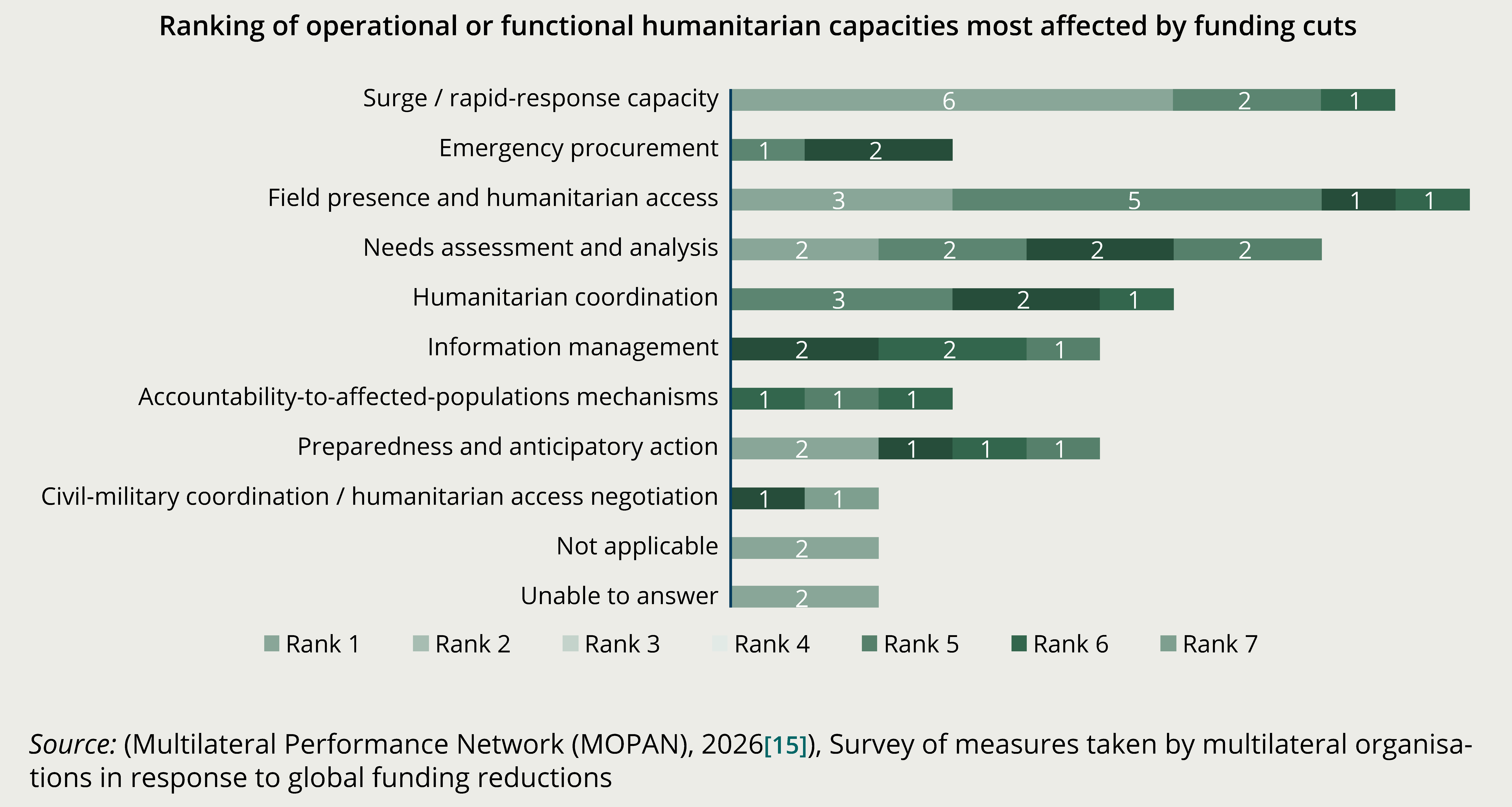
At the same time, some of the operational capacities needed to identify needs, maintain access and scale a response are themselves under pressure. Field presence and humanitarian access were the capacities most frequently identified as affected, reported by ten respondents, followed by surge and rapid-response capacity (nine), needs assessment and analysis (eight), humanitarian coordination (six), and information management and preparedness (five). Protection and early recovery were the humanitarian sectors most frequently ranked as affected.
Figure 13. Funding cuts are constraining field presence, humanitarian access and surge capacity
While the ‘hyper-prioritisation’ of humanitarian assistance may be a necessary measure to ensure that limited resources are directed towards the most acute and life-saving needs, it inevitably involves difficult trade-offs. At inter-agency level, prioritisation is informed by collective, multisectoral needs analysis through the Humanitarian Programme Cycle, including the intersectoral severity analysis of the Joint Intersectoral Analysis Framework, rather than by the severity classification of any single sector. These trade-offs nevertheless reduced geographical coverage, less targeted support for certain vulnerable population groups, and the scaling back of longer-term interventions that are critical for supporting recovery, building resilience, and strengthening preparedness for future crises. WFP has highlighted the risk that people already facing emergency levels of food insecurity but living outside prioritised areas may receive less or no assistance, allowing conditions to deteriorate and potentially increasing the scale and cost of support required later . Country evidence illustrates the wider dynamic: in parts of Mali, reduced food rations were associated with a substantial subsequent increase in acute hunger, while funding gaps elsewhere have forced WFP to reduce assistance before needs themselves have declined .
Trade-offs can also arise as collective priorities are translated into sectoral and programmatic choices. UNFPA has cautioned against an interpretation of life-saving assistance that gives priority to food, water and shelter while treating sexual and reproductive health and protection from gender-based violence as secondary. In its 2026 Humanitarian Action Overview, UNFPA warned that constrained resources were forcing increasingly difficult prioritisation decisions and that entire populations could fall outside the response even while their needs remained acute. It reported that more than 1,000 supported health facilities and mobile teams had closed or were close to closure during 2025, alongside more than 250 safe spaces .
This also applies to prevention and anticipatory action. Agricultural support that arrives after a planting season, preparedness that is deferred until after a shock, or assistance withheld until households cross a higher severity threshold may reduce expenditure in the immediate response but increase future humanitarian requirements. The continued investment in anticipatory action reported by several survey respondents therefore represents an attempt to avoid a narrower focus on current severity translating into higher needs later.
However, ‘hyper-prioritisation’ has not resulted in a uniform retreat from preparedness and resilience programming. Seven survey respondents reported increasing preparedness or anticipatory action, compared with two reporting reductions, while resilience work increased in five organisations and declined in four. Resilience work increased for five and declined for four organisations. This suggests that some organisations may be seeking to protect investments that can prevent needs from worsening even as scarce resources are concentrated on immediate life-saving needs.
FAO and WFP’s El Niño appeal, for example, explicitly sought to reach communities before critical agricultural windows closed: available resources could initially cover around 1.2 million people, while a further USD 167 million was required to extend anticipatory support to another 7.6 million people .
Locally-led approaches to crisis response might be more mixed than the sharper focus on immediate needs.
The MOPAN 2025 mapping report found declining support to local partners and warned that funding reductions risked reversing progress towards community ownership and sustainability. In the 2026 results, there is an emerging tension between greater localisation and constrained resources. Local and national actors are being given greater roles in delivery, leadership and partnerships, while the funding and capacity available to fulfil those roles remain uneven. Eight of 25 respondents reported greater use of local actors, and 11 of 17 humanitarian respondents considered devolution and localisation to be advancing through deliberate reform. However, this greater role is not consistently accompanied by more funding. Among humanitarian respondents, five reported reduced funding to local and national actors and only two reported increases. Across the wider sample, 13 organisations reported reductions in funding channelled to partners.
Pooled funding provides an important counterpoint. OCHA, for instance, has sought to increase the share of pooled funding channeled to local actors. By the end of 2025, 55% of Country-Based Pooled Fund allocations had gone to local and national partners, including 17% to local women’s organisations. This is the highest proportion ever, with ambitions to do more in 2026. FAO reported continuing to invest in people and systems for cash and voucher programming despite the funding constraints, and using OCHA pooled funding to increase financing to national and local actors (2026, MOPAN Survey – FAO)
Normative, policy and knowledge functions continue to be narrowed
Beyond the effects on direct delivery described above, funding reductions are affecting the technical, policy, knowledge and coordination functions through which organisations translate their mandates into support to countries and collective and sustainable results. Looking beyond direct service delivery, the ranking provided by organisations shows substantial pressure across upstream functions. Of the 15 respondents able to provide a substantive ranking, ten included capacity development or technical assistance among the affected functions; eight included knowledge, data and research work, and coordination and partnerships; seven included policy work; six included advocacy and convening; and five included normative work.
This complements the funding-source analysis presented in the previous section: reductions in assessed and flexible resources can have particular implications for functions that are difficult to finance through earmarked projects.
Figure 14. Funding pressures are narrowing technical, knowledge and policy functions
UNEP provides a clear example of the breadth of functions exposed. Its Environment Fund and UN Regular Budget both fell below planned levels in 2025, while staffing reductions, recruitment restrictions and expenditure controls accompanied the lower resource envelope. UNEP identified environmental science, environmental law and standards, policy co-ordination, capacity development and convening among the functions supported by these funding streams. Its response has included organisational consolidation, including combining the Early Warning and Assessment Division with the Office of the Chief Scientist to create an Office of Science, alongside a wider functional review intended to preserve priority capabilities under a smaller resource envelope . Similarly, UNESCO reported cancelled regional SDG 4 coordination meetings in Central Africa and the postponement of the SDG4 coordination meeting in the Arab States, while its Intergovernmental Oceanographic Commission also entered 2026–27 with a 29% vacancy rate among professional and higher staff, with risks to reporting, systems support and capacity development if additional resources were not secured
WHO has rationalised or discontinued selected clinical-trial platforms, technical tools and assessments, reduced publication volumes and the number of stand-alone technical products, and scaled back support to some inter-agency coordination mechanisms while seeking to protect its core normative mandate
OHCHR illustrates impacts both on delivery of its human rights mandate and on its wider role in mainstreaming human rights across the UN system. Funding constraints led to postponed reviews of 35 State reports and more than 230 individual complaints, four of eight planned visits by the Subcommittee on Prevention of Torture being postponed, and reduced investigative and field capacity. They also affected OHCHR’s system-wide support: requests to deploy Human Rights Advisers to 12 UN Country Teams could not be funded This is significant because Human Rights Advisers support Resident Coordinators and UN Country Teams to integrate human rights into country analysis, programming, prevention and other UN activities.
These examples are directly linked to MOPAN's 2025 analysis “Closing the UN Mandate–Results Gap” which found that normative and advisory functions were already under-resourced and that projectised funding creates incentives to favour visible delivery outputs over functions such as policy advice and capacity development .
Oversight and accountability functions are being deliberately protected, but are not exempt from funding pressures
Organisations appear to be protecting internal oversight, integrity and assurance functions more deliberately. When respondents were asked to rank the oversight functions most affected by funding reductions, uncertainty or related reform measures, 10 of 25 (40%) selected “not applicable” and three were unable to identify an affected function. Across all ranks, monitoring was identified by seven respondents, evaluation by six, and internal audit and ethics by four each.
Open responses provide stronger evidence of deliberate protection among organisations that are making substantial reductions elsewhere. WFP reported prioritising the safeguarding of oversight and independent offices, with their annual budget reduction lower than the average reduction for other functions; it also used central evaluation funding to support country-office evaluations. WHO reported that its corporate accountability functions were largely protected. The ILO stated that the Director-General had ringfenced oversight functions, while UNHCR applied a smaller reduction in staff positions to integrity and management functions than to most other functions and maintained their organisational independence
Relative protection does not mean that capacity is unchanged. Gavi reported reducing its monitoring and evaluation operating budget by approximately 50% and M&E staffing by 31%, while maintaining funding for independent evaluations (MOPAN Survey, 2026 – Gavi). UNHCR’s Evaluation Office also reported a lower resource envelope and a more selective evaluation programme, including only one new global thematic evaluation planned at the time of reporting . WHO likewise preserved the independence of its internal oversight function while reducing vacant posts and investigation consultancy capacity as part of its wider realignment .
Cross-cutting commitments are being protected on paper, but implementation capacity is thinner
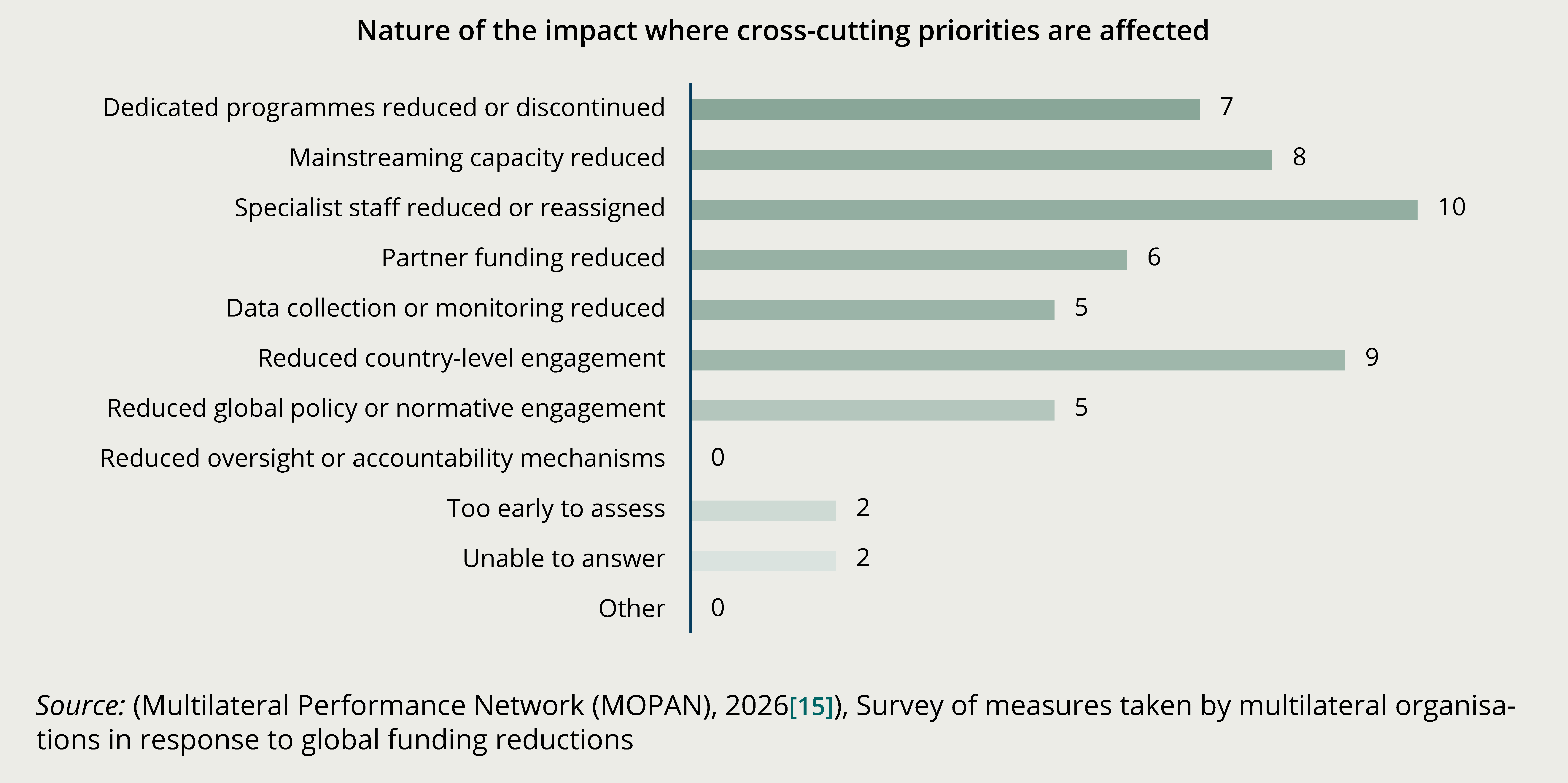
Cross-cutting commitments are generally being retained in organisational strategies and priorities, but funding pressures are reducing the capacity available to implement them. Gender equality and women’s empowerment was the cross-cutting area most frequently identified as affected, selected by 48% of respondents (12 of 25), followed by “leave no one behind” and inclusion at 44% (11). Human rights or protection and disability inclusion were each identified by 36% (9), while climate or environmental sustainability was identified by 28% (7) and localisation by 24% (6).
The more consistent pattern concerns how these commitments are operationalised. Among the 16 respondents for whom the follow-up question was applicable, pressures were most apparent in the people and capacity needed to translate cross-cutting commitments into practice: nearly two-thirds reported that specialist staff had been reduced or reassigned, more than half reported reduced country-level engagement, and half reported lower mainstreaming capacity. Smaller but still substantial shares reported reductions in dedicated programmes and partner funding, while around one-third reported reduced data collection or monitoring
Figure 15. Funding pressures are reducing the capacity to implement cross-cutting commitments
For example, the Global Fund reported that the main effect of funding reductions was on the scale and scope of support for these themes rather than the underlying commitments. WHO reported that gender, disability inclusion and human rights were comparatively protected as part of its core normative mandate, although country support became more selective. Gavi retained its formal commitments while reducing specialist capacity, partner funding and some monitoring activities and FAO reported maintaining and strengthening its gender architecture, including an additional senior gender post, while constrained funding reduced the resources available for gender programming, technical support to country offices, staff development and partnerships on inclusion, and specialist capacity for protection mainstreaming (MOPAN survey, 2026).
This is an important qualification to MOPAN’s 2025 finding. Human rights, inclusion and gender commitments are not uniformly “losing ground” as policy objectives, but the infrastructure through which those commitments are delivered – specialist staff, partner support, country engagement, data and monitoring – is under pressure.
Comparative advantage is informing more deliberate organizational prioritisation, but overlaps remain
Organisations are making more considered choices around the reallocation of scarce resources than was visible in 2025, with organisational priorities and comparative advantage increasingly used to guide which functions and thematic areas are protected, reduced or transferred.
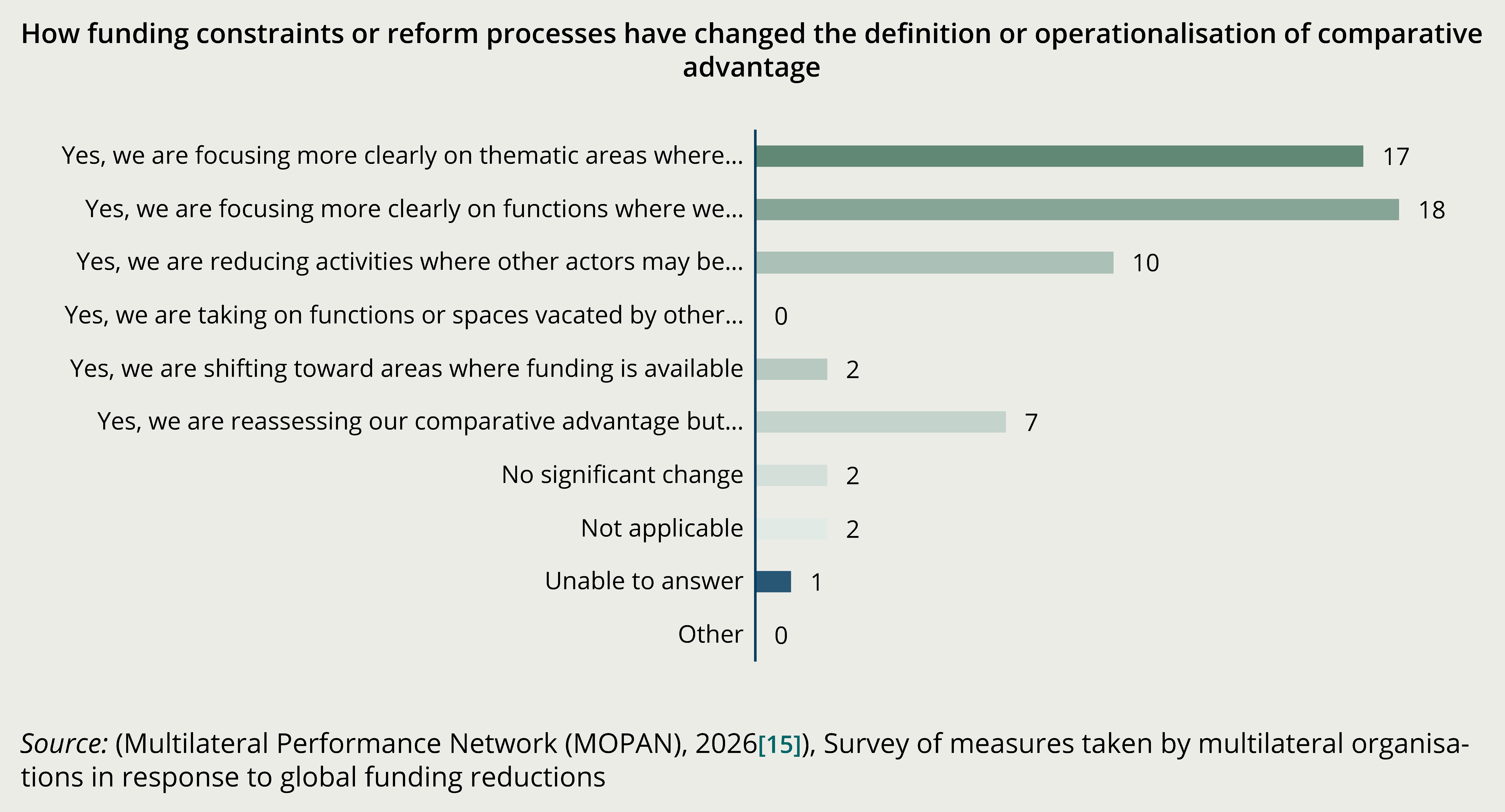
Twenty of the 25 respondents reported some change in how they define or operationalise comparative advantage. Eighteen were focusing more clearly on functions where they have a recognised lead role and 17 on thematic areas where they have a recognised lead role, while seven were still reassessing their comparative advantage. Only two reported shifting towards areas primarily because funding was available.
Figure 16. Comparative advantage is increasingly guiding organisational prioritisation
UNHCR, for example, reported that funding constraints had reinforced its focus on international protection, solutions, refugee inclusion, advocacy and support to governments, while relying more on partners for large-scale investment and service delivery (MOPAN Survey, 2026 – UNHCR). FAO has similarly sought to protect functions it considers central to its comparative advantage, including normative and standard-setting work, data and early warning, its country network and transboundary animal-disease response capacity
This represents a clearer element of strategic choice than was apparent in the 2025 mapping, which warned that mandates were at risk of narrowing through attrition, as each organisation identified separate cost-saving measures That risk remains. The 2026 evidence shows some organisations increasingly using comparative advantage to guide what functions or priorities they protect or reduce.
“Funding constraints have reinforced UNHCR’s focus on areas where it has a unique mandate and comparative advantage, particularly international protection, solutions, refugee inclusion advocacy and support to governments.” (MOPAN survey, 2026 – UNHCR)
However, a recognised lead role does not in itself establish comparative advantage relative to other actors: it may reflect mandate, expertise, institutional experience or country demand. A more systematic assessment would require an impartial consideration of the respective roles and capabilities of different organisations. This is consistent with MOPAN’s 2026 brief Beyond Overlaps: Leveraging Comparative Advantage for Multilateral Collaboration, which argues that comparative advantage needs to be defined relationally across organisations and linked to shared accountability and funding arrangements, rather than articulated by each organisation in isolation.
Focus on perceived comparative advantage is visible in some cases, but systematic division of labour remains unclear. Some organisations are going beyond internal prioritisation by considering who else is better placed to perform a function and adjusting their roles accordingly to reduce duplication. In the survey, ten organisations reported reducing activities where other actors may be better placed, but concrete examples of reallocation through a relational assessment of comparative advantage remain limited.
WHO has reduced overlap in areas where another UN entity has a clearer mandate or stronger delivery role, while retaining normative and technical responsibilities. Examples include stepping back from parts of sexual and reproductive health and protection-related delivery where UNFPA or UNICEF are better placed, and transferring selected logistics, training and innovation functions to other providers WHO asked UNFPA to lead the SRH Task Team at global level and to coordinate SRH working groups under the Health Clusters at country level, while UNFPA will continue to manage the distribution of IARH kits.
UNAIDS is transferring 11 of its 15 former Secretariat functions to its Cosponsors, rather than simply discontinuing them . Separately, UNCTAD and DESA are co-leading work on joint knowledge hubs and macroeconomic analysis, including a joint commodities and governance team with the Economic Commission for Africa and a consolidated flagship publication (UNCTAD, 2026).
A similar logic is emerging within the global health architecture. The Global Fund reported a more deliberate division of labour with partners including Gavi, the World Bank and Africa CDC, distinguishing areas where it should lead, partner or rely on other actors. Gavi similarly described clearer role definition and “merging at the last mile” where joint approaches can improve country-level delivery (MOPAN Survey, 2026 – Global Fund and Gavi)
“Funding constraints and ongoing global health reform discussions have reinforced the Global Fund's focus on its comparative advantages rather than fundamentally changing them. (…) The Global Fund is also pursuing a more deliberate division of labor with partners, emphasizing collaboration to reduce duplication and fragmentation, clarifying where it should lead, where it should partner, and where other actors are better placed”. The Global Fund (2026 MOPAN Survey)
These examples are different from simply cutting lower-priority activities. They involve an assessment of whether another organisation or system is better positioned to perform the function. The available evidence does not show that this approach is being applied consistently across the system or that all transfers are accompanied by an assessment of the finance and capacity needed by the receiving actor. Moreover, refocusing on perceived comparative advantage at the organisational level still falls short of an examination of comparative advantage across the system that could lead to a redefinition of the division of labour.
There is limited evidence that the functions and geographies that organisations leave are being covered by others. The evidence shows that organisations are reducing, discontinuing or transferring some functions and geographic presence, but there is not yet a systematic picture of whether other actors, including governments, local or national actors, or NGOs not captured by the survey, are able to fill the resulting gaps. As documented in preceding sections, organisational adjustment has included reduced programme coverage, office closures and consolidation, narrower technical and analytical capacity and, in some cases, explicit transfer of functions. The relevant question is therefore not whether exits are occurring, but whether they form part of a coherent redistribution of roles.
None of the 25 respondents reported that their organisation was taking on functions or spaces vacated by another actor. This does not mean that no substitution is occurring: responsibilities may be taken on by governments, NGOs or organisations, without this being visible in the survey data.
The humanitarian responses provide a more direct indication of the potential risk. Of the 17 humanitarian organisations answering whether they were withdrawing from a function, sector or geography that they believed no other actor was positioned to cover, three said yes, five said no and six considered it too early to assess. The high level of uncertainty is itself relevant: in a rapidly changing funding environment, organisations may be reducing or exiting roles before it is clear who, if anyone, will absorb the function.
Taken together, the evidence suggests that many organisations are narrowing their focus around functions and areas where they see themselves as having a recognised lead role. This could result in reduced duplication and some efficiency gains. However, because funding and capacity are declining across several organisations at the same time, functions or geographies they leave are unlikely to be fully picked up by others. The result is therefore likely to be some loss of collective coverage and system-wide capacity.