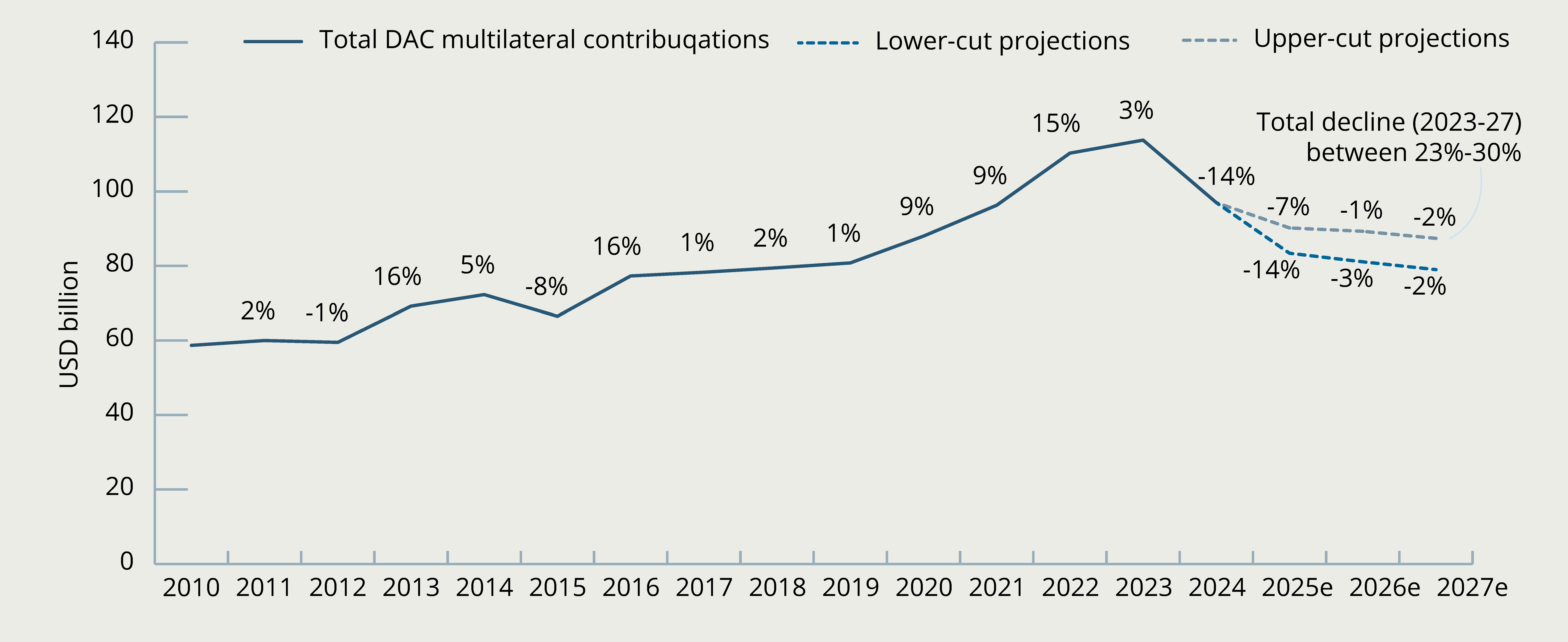
MOPAN’s 2025 mapping, reflecting information available as of 15 September 2025, already identified signs of a structural contraction in multilateral funding for development and humanitarian assistance, and warned that organisation-level adjustment was moving faster than the wider reform processes intended to manage that change (Multilateral Performance Network (MOPAN), 2025[1]). At that point, however, the full-year scale of the 2025 contraction in official development assistance (ODA), its likely near-term trajectory and the implementation status of several system-wide reform initiatives were not yet clear. By the time of this analysis, the financing downturn has become more measurable and its persistence more evident.
Preliminary OECD DAC data put ODA from DAC members and associates at USD 174.3 billion in 2025, equivalent to 0.26% of their combined GNI and a 23.1% real decline from 2024 on the grant-equivalent measure. Twenty-six of 34 providers reduced their ODA. The contraction was nevertheless highly concentrated: France, Germany, Japan, the United Kingdom and the United States accounted for 95.7% of the aggregate decline, with the United States alone accounting for 75.1% (OECD, 2026[2]). The cuts also extended beyond more volatile components of aid. Net bilateral expenditure on development programmes, projects and technical co-operation - excluding humanitarian assistance, in-donor refugee costs and debt relief - fell by 26.3%, while humanitarian assistance declined by 35.8% (OECD, 2026[2]).
The OECD’s June 2026 projections indicate that the contraction is likely to continue, although at a slower pace than in 2025. On the net-flow measure used for forward projections, ODA declined by 23.3% in 2025 after an 8.5% fall in 2024 and is projected to fall by a further 6.9% in 2026, to around USD 152 billion - the lowest level since 2014 (OECD, 2026[3]). This strengthens the evidence that the contraction in development co-operation is continuing beyond 2025, rather than returning to the growth trajectory that preceded 2024.
The multilateral system is exposed to this contraction, but unevenly. Core multilateral ODA fell by 12.7% in 2025 to USD 47.9 billion. Core contributions to UN entities fell by 27%, whereas ODA-eligible core support to the World Bank institutions and funds – notably IDA – increased by 6.4%, and support to regional development banks by and 11.9% (OECD, 2026[2]). The increases for both the World Bank and regional development banks in 2025 largely reflected disbursements from previous replenishment cycles. In 2026, core funding is projected to decline by a further 4.8% for the UN, 6.3% for the World Bank and 5% for regional development banks (OECD, 2026[3]).
The distinction between donor contributions and the financing that multilateral organisations subsequently provide is particularly important for the MDBs. Their capital structures, market borrowing and previously agreed replenishments can allow lending volumes to remain relatively resilient even when current donor ODA falls.