UNAIDS, UNHCR, WHO, WFP and OHCHR experienced substantial reductions in resources available for their core or operational work. UNAIDS reported that core funding had fallen by more than half since 2024 and reduced the capacity of its Secretariat and Cosponsors by more than 50% (UNAIDS Programme Coordinating Board, 2026[16]); UNHCR reported that in 2025 only 37% of the $10.604 billion operational budget was funded, resulting in a global funding shortfall of $6.7 billion – the biggest in UNHCR’s recent history (UNHCR, 2026[17]) and WHO faced unpaid assessed contributions, terminated voluntary agreements and continuing earmarking constraints, leaving a significant salary and programme gap despite apparently high aggregate financing when projected resources were included (WHO, 2025[18]).
WFP’s confirmed contributions fell by 33%, from US$9.8 billion in 2024 to US$6.5 billion in 2025, covering only 41% of operational requirements. Its 2026 provisional implementation plan represents 59% of requirements and is designed to assist 94 million people, compared with approximately 110 million under full funding (WFP, 2025[19]) (WFP, 2026[20]) while OHCHR received US$191.5 million of its US$246 million approved regular-budget resources in 2025 and US$257.8 million against an extra-budgetary requirement of US$500 million (OHCHR, 2026[21])
FAO also broadens the picture. Voluntary contributions fell by 8% in 2025, while traditional-donor funding was reported to be around 15% below 2024; increased reliance on vertical funds partly offset the volume decline but reduced flexibility (FAO, 2026[22]). Regarding some of the organisations with normative mandates, UNESCO faced a USD 75.4 million non-payment of its 2025 assessed contribution and limited implementation of its USD 685.4 million regular budget to approximately USD 610 million, about 11% below the approved level ( (UNESCO, 2026[23]), while for UNEP’s case, the Environment Fund income was USD 84.9 million against a USD 100 million budget in 2025, while UN Regular Budget income was USD 20.7 million against USD 24.5 million (UNEP, 2026[24]) (UNEP, 2026[25]).
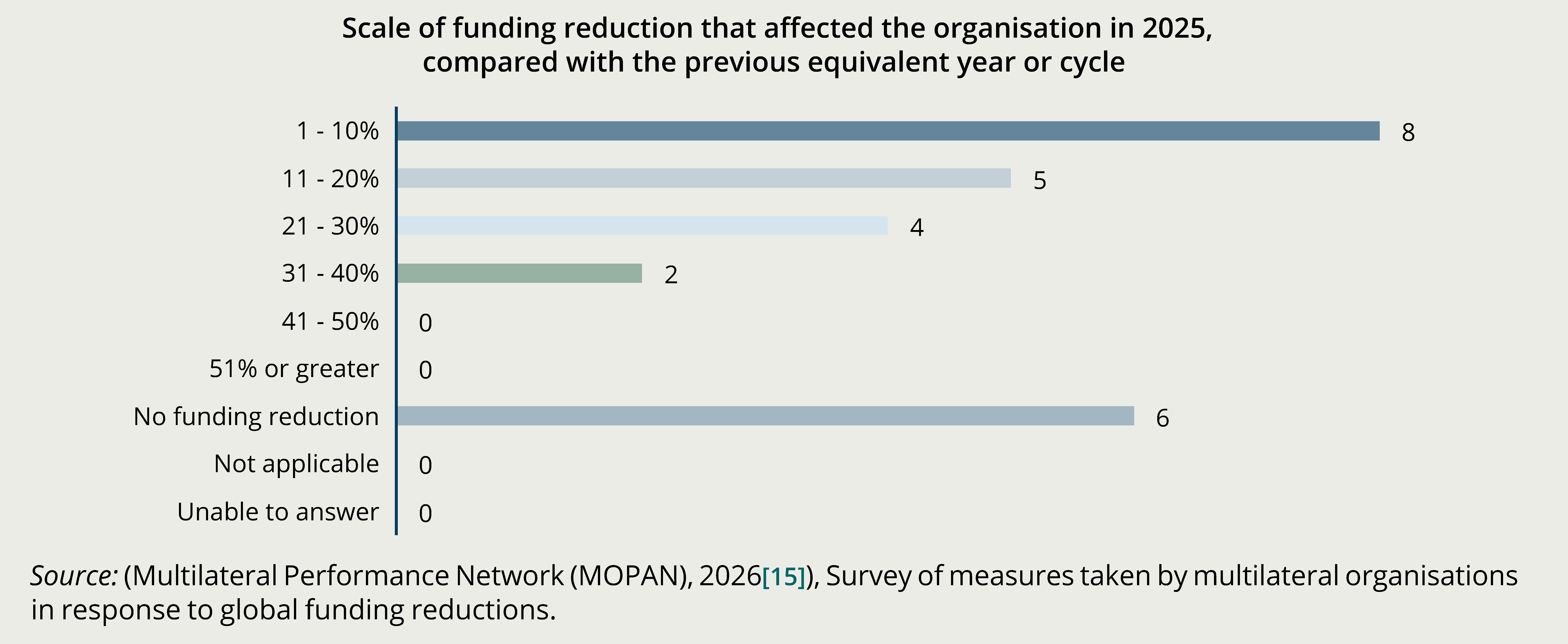
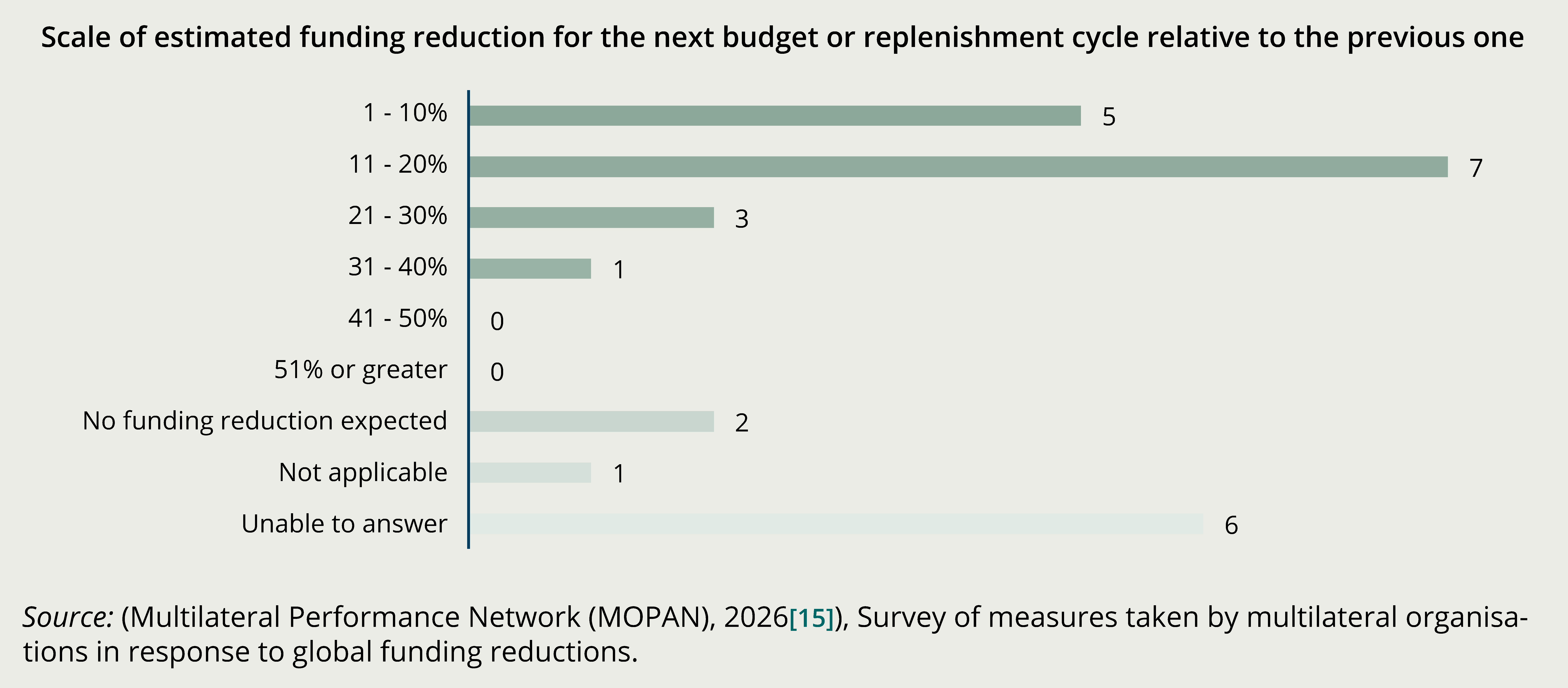
Some of the initial estimates were more pessimistic than the reductions subsequently reported. In response to the 2025 MOPAN survey, 12 of the 14 organisations able to provide a forward estimate expected a reduction, and seven expected it to be at least 21%. Among 12 organisations for which the expected 2025 band and the subsequently reported realised band are broadly comparable, eight reported a lower realised reduction than they had anticipated, two (2) a higher reduction and two (2) approximately the same. The comparison is indicative only because the questions, samples, baselines and funding bands are not fully identical. It may nevertheless suggest that some organisations mitigated or deferred part of the anticipated near-term loss.
“While income decline was originally not as steep as projected and UNICEF has shown resilience, this largely reflects timing effects and one-off factors rather than a substantive improvement in the funding environment.” (MOPAN survey, 2026 – UNICEF)
This distinction is important. Smaller-than-expected reductions do not necessarily indicate that the funding environment improved. Several organisations responding to the survey attributed apparent resilience to one-off receipts, use of reserves, successful mobilisation of non-core resources, support from programme countries, new donors, co-financing or replacement of flexible resources with more restricted contributions (Multilateral Performance Network (MOPAN), 2026[15]).
UNOPS provides a different example of resilience. In the 2025 survey, it anticipated a 1–10% reduction in parts of its portfolio, while expecting this to be fully offset by increased demand for other services. This expectation was borne out in 2025. In its 2026 survey response, UNOPS reported USD 2.7 billion in project implementation for 2025, broadly unchanged from 2024, while new agreements signed with partners exceeded USD 3 billion, above previous years. Unlike most organisations covered by the survey, UNOPS does not receive assessed or voluntary contributions (2026, MOPAN Survey – UNOPS). As a demand-driven, fee-for-service organisation, UNOPS was able in 2025 to offset lower demand in some parts of its portfolio with growth elsewhere.
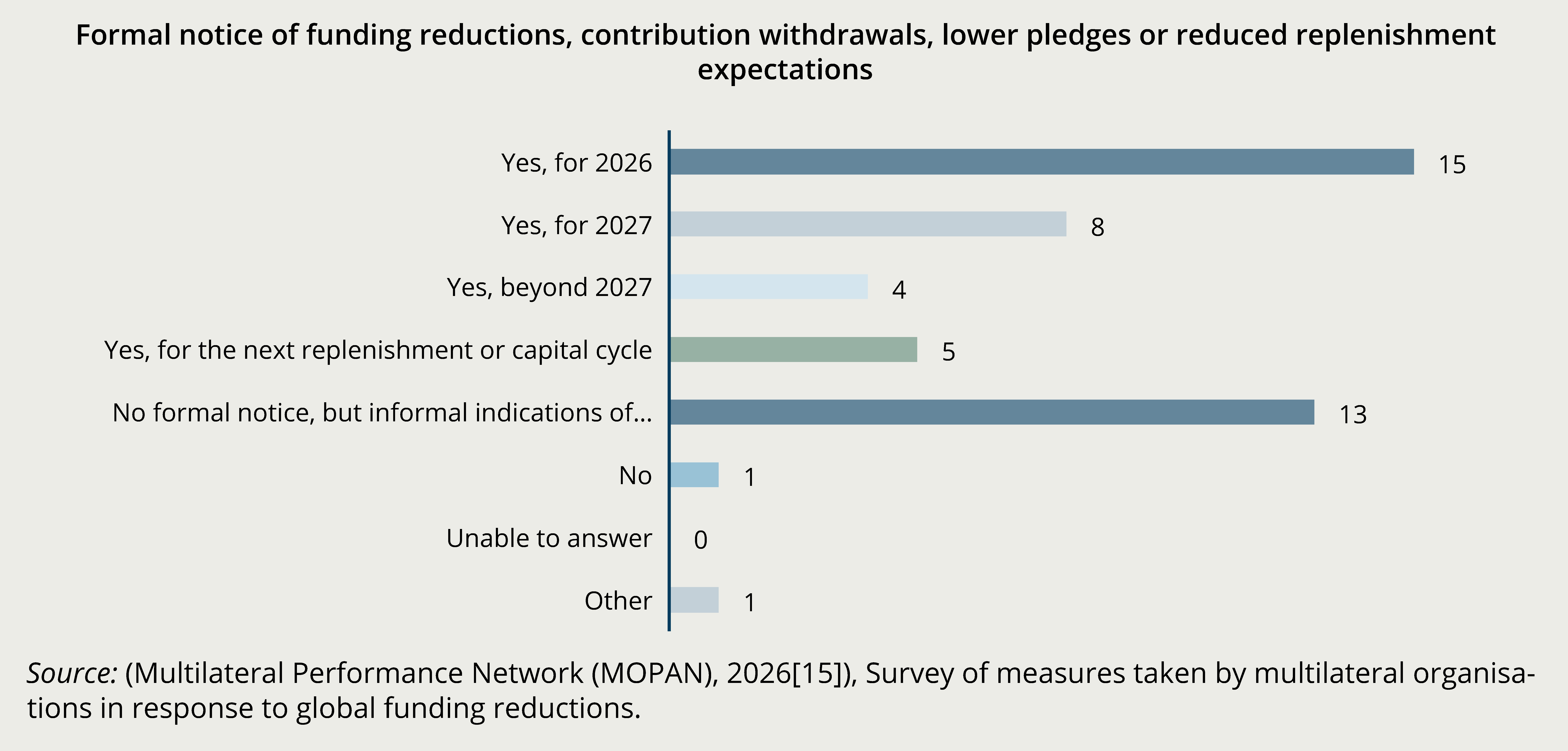
More importantly for the forward outlook, 20 respondents had received at least one formal notice of a reduction, contribution withdrawal, lower pledge or reduced replenishment expectation (either for 2026, 2027 or beyond). Including informal indications, 23 of 25 respondents reported some expectation of further pressure.