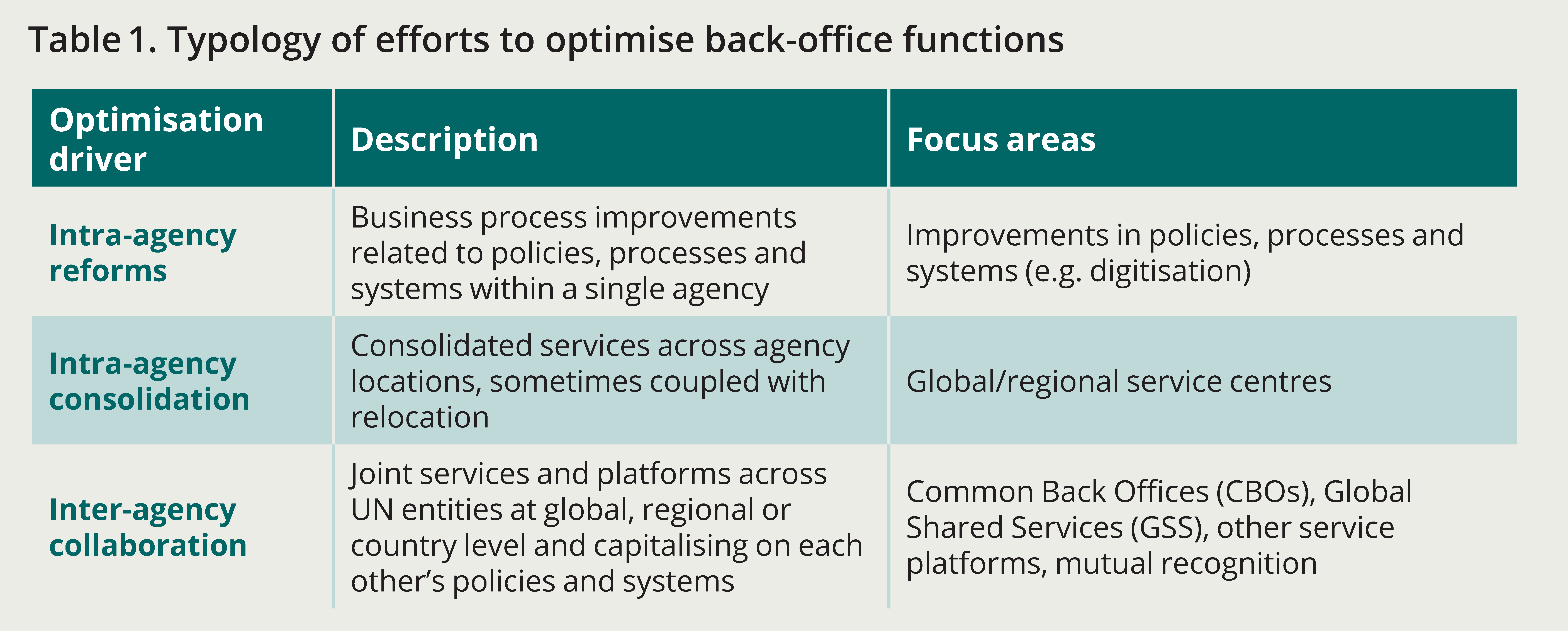
There has recently been a deliberate effort to expand inter-agency shared services to reduce costs, alongside a renewed focus on improving service quality. There is a longstanding tradition of shared services in the field, largely operating on an ad-hoc basis for decades. These arrangements have been progressively formalised through Memorandum of Understandings (MoUs) and Long-Term Agreements (LTAs), marking the starting point for subsequent efforts on horizontal integration. Sharing of best practices and related work has also been ongoing through the High-Level Committee on Management (HLCM). Global attention to shared services gained further momentum with the appointment of the Independent Team of Advisers by the United Nations Economic and Social Council (ECOSOC) President in 2016 and following a 2017 call from the UN General Assembly to adopt more cost-efficient support services by reducing duplication of functions, minimising administrative and transaction costs, and enhancing the quality of services by creating dedicated capacity. In 2017, the UN Secretary-General set a number of reform targets – collectively referred to as the “efficiency agenda” – and tasked the Business Innovations Strategic Results Group (BIG) to maximise programmatic gains through efficient and high-quality back-office operations (BIG, 2019)17. Some organisations now offer these services at the country, regional or global level. Common Back Offices (CBOs)18 – also known as local shared services – are country-level platforms that deliver location-specific common services outlined in the Business Operations Strategy (BOS).19 In addition, new initiatives or pre-existing Regional and Global Shared Service Centres provide location-independent shared services across several organisations.
A major milestone in 2024 was the advancement of the first UN CBO in Nairobi, serviced by the United Nations Office at Nairobi (UNON) as a main provider together with UNICEF. It provides harmonised cash transfers and for WFP, logistic services. It offers 101 services under 5 service lines20, consolidating administrative, finance, human resources, procurement and ICT, and logistics services to over 3 500 staff members across 25 UN entities. The CBO in Brazil offers 86 services to 15 UN entities and approximately 1 200 UN personnel. The CBO in Vietnam offers 119 services, both with UNDP as the host.21 Similar efforts are underway, with priority initiatives in Tanzania and Senegal, and ongoing efforts in other countries like Bangladesh, Colombia, and Indonesia.22
Local inter-agency shared services show slow progress, limiting the ability to test efficiency gains at scale. The initial target of 100% of countries with a CBO by the end of 2022 was reduced to 50 countries by the end of 2024, with the first CBO established in early 2024 (see above).23 To date, there are only 4 functioning CBOs, with the latest 2024 data reporting a cost-saving of USD 1 million out of the expected USD 77 million.24
There has been progress in providing and using inter-agency Global Shared Services (GSS), although there is no set target for service uptake. As of 2024, seven UN entities had agreed to collaborate on GSS: the UN Secretariat, UNDP, UNOPS, WFP, UNHCR, the United Nations International Children's Emergency Fund (UNICEF) and the World Health Organization (WHO). Some entities have set up their own global service centres for use by other agencies for a fee, while new inter-agency initiatives have also emerged. Out of 43 service ideas, only 10 were deemed mature and ready for scaling (see Annex B). While anecdotal evidence from MOPAN assessments confirms that agencies are increasingly using global services25, there are no set targets for agency uptake as participation in shared services remains entirely voluntary. These services are mostly provided through the following initiatives, with the previously mentioned UNDP GSSC having the most signed-up entities:26
GSSC, established in 2003, is a UNDP-managed centre delivering tailored HR and finance services. It serves over 40 000 UN personnel from various agencies, funds and programmes across more than 170 countries. GSSC operates from eight locations: Addis Ababa, Amman, Bangkok, Copenhagen, Dakar, Istanbul, Kuala Lumpur and New York.27
The UN Web Buy Plus is a global e-commerce solution, active since 2000 and managed by UNOPS. It supports procurement in 128 beneficiary countries, offering 260 product categories and over 100 suppliers.28
The United Nations Fleet is a joint initiative launched in October 2022, with WFP and UNHCR providing light vehicle leasing services to UN entities. Operating independently under a neutral governance structure, it is staffed by personnel seconded from both agencies. UN Fleet has global reach and is supported by three Vehicle Preparation Centres in Rotterdam, Dubai and Thailand.29
The United Nations Booking Hub (also called UN Mobility), launched by WFP, is a digital platform that streamlines bookings for inter-agency field services. It supports personnel in over 110 countries, offering services such as transportation, accommodation, office space, medical support, mobility and wellness services.
Some overlap has emerged across inter-agency GSS. Multiple agencies are offering similar support, particularly in finance, human resources and procurement (see Annex B). However, among services identified for scale-up, a clearer division of labour seems to have been established in principle, with UNDP positioned as the lead provider for finance and HR, and UNOPS taking the lead on procurement. However, this structure is not binding, and, in practice, agencies are free to choose the provider that best suits their needs. Such overlaps are not inherently negative, as redundancy can support risk management and competition for greater efficiency and better-quality services.
Shared services involve significant trade-offs that are not easily captured in cost-saving evidence. UN entities often report efficiency gains from shared services, such as reduced administrative overhead or economies of scale. Expected targets related to entity-specific savings realised through GSS were almost realised in 2024, with a USD 121 million saved out of the expected USD 126 million.30 However, these figures rarely reflect the underlying loss of institutional knowledge, reduced strategic capacity and control, the persistence of parallel systems and the risk of inadequate quality that can offset expected savings.
A related observation concerns the apparent evaluation gap regarding the "efficiency agenda" component of the 2017 United Nations Development System (UNDS) reforms. In 2024, SWEO undertook an analysis of evaluation coverage across key themes identified in the 2020 Quadrennial Comprehensive Policy Review (QCPR).31 The findings revealed that the inter-agency efficiency agenda – particularly in relation to business operations – has received minimal dedicated evaluative attention. Notably, even the annual evaluations of the Resident Coordinator (RC) system conducted by OIOS have explicitly excluded this area from their scope. Furthermore, evaluations focusing on Human Resources (HR) issues appear to be particularly scarce. From a sample of approximately 1 000 strategically significant evaluations published by UN entities between 2021 and 2024, only ten were identified as containing detailed analysis on HR-related matters.