This paper presents the key messages emerging from MOPAN Insights reports that are part of the series Multilateral Effectiveness in a Shifting Landscape: a mapping of measures taken by multilateral organisations in response to the current funding environment (2025), and three thematic briefs on efficiency (2025), mandate implementation (2025), and comparative advantage (Jan. 2026). It also outlines key recommendations that MOPAN members and other UN Member States may wish to consider as they implement the UN80 initiative.
Multilateral Effectiveness in a Shifting Landscape: Key messages

Context
Overview
The multilateral system is confronting a shifting funding landscape that is testing the resilience of international organisations. Findings from MOPAN show that recent budget cuts have been rapid and deep and cut across several UN entities and vertical mechanisms– ranging from 11% to 30% for 2025–27 and in some cases exceeding 50%. This shift is driving staffing and programmatic downsizing, as well as structural changes, faster than UN reform processes can keep pace.
This “reform by attrition” means that austerity, rather than strategy, is dictating changes: critical capabilities in policy, normative support, oversight and local partnerships are being hollowed out just when they are most needed. The impact of abrupt, unco-ordinated cost-cutting extends beyond efficiency alone – it skews priorities toward short-term outputs, undermines oversight and accountability, and ultimately puts governance and trust at stake. These trends risk eroding the global public goods agenda and progress towards the Sustainable Development Goals.
There is thus an urgent need to shift from reactive cutbacks towards a more collective and strategic approach to reform: one driven by joined-up donor dialogue and co-ordination, rather than isolated measures. The UN80 Action Plan1 presents an opportunity to realign incentives behind key functions and capacities across the system, while generating efficiencies where possible.
Fragmentation remains the central obstacle to multilateral effectiveness, cutting across funding, efficiency, mandates and collaboration. MOPAN’s analysis finds that overlapping mandates, blurred functions, duplicative country footprints and weak co-ordination mechanisms have created a fragmented system that increases costs, dilutes impact and undermines coherence. In many ways, today’s fiscal crisis is exposing these fault lines.
Impact of rapid and unco-ordinated cost-cutting
While efficiency measures would normally seek to enable UN entities to ‘do more with less’, they are left with no choice but to do less with less: reducing staff, closing offices and scaling back programs. Most entities have resorted to short-term cost-cutting – hiring freezes, travel restrictions, staff relocations to cheaper duty stations – often without a co-ordinated strategy with other organisations.
Such ad hoc measures may balance budgets in the immediate term, but they undermine long-term resilience and reform objectives. For example, several agencies report that cuts disproportionately hit oversight, evaluation and policy functions, as well as operations in the poorest and most fragile contexts, and local partnerships.
This not only threatens program quality and accountability but also poses risks to transparency and trust in the multilateral system. These developments underscore the importance of a more deliberate, system-wide response to funding pressures, so that inevitable adjustments are guided by strategic prioritisation rather than across-the-board attrition.
Unlocking efficiency
Efficiency initiatives are a pillar of the response to funding cuts. Thus far, many organisations have introduced efficiency drives – consolidating administrative services, streamlining workflows, and exploring common back-office solutions – in an effort to maintain delivery with fewer resources.
➢ However, MOPAN evidence cautions that savings must be pursued with a long-term, system-wide lens. Efficiency gains are indeed possible, but only if trade-offs are proactively managed and core capacities safeguarded.
For instance, consolidating administrative functions - such as through shared service centres or common payroll hubs - can lower operating costs. MOPAN’s brief Doing Better with Less: Unlocking Efficiency in the UN confirms that such administrative consolidation can generate savings, and the UN Secretariat’s plan for new shared service hubs mirrors reforms already underway in some agencies.
➢ However, these measures must be built on clear governance arrangements, transparent cost-sharing models, and robust monitoring of service quality if common services are to succeed. Experience shows that without these, administrative consolidation carries significant risks: service quality may decline, responsiveness to local needs can suffer, and institutional knowledge may be lost in the shuffle. Indeed, past efforts at joint back offices delivered savings but proved fragile, often failing to account for sunk costs and eroding institutional memory in the process.
Similarly, proposals to relocate functions and reduce high-cost staff posts - for example, moving roles from New York or Geneva to regional hubs - reflect long-standing efficiency debates. These moves can indeed reduce expenditure on salaries.
➢ However, short-term savings often obscure transition risks. MOPAN evidence shows that most UN entities lack strong strategic workforce planning. Without it, large-scale headcount reductions or relocations risk eroding core expertise and institutional memory. Key functions in oversight, risk management and technical guidance could be lost before mitigation measures are in place. The lesson is that workforce changes must be guided by strategy and supported by careful transition planning, not driven solely by cost-cutting imperatives.
UN80’s efficiency measures, now being integrated into the 2026 regular budget, should therefore be scrutinised not only for immediate savings but for longer-term effects on delivery capacity, sustainability of results, and system-wide coherence. Without this perspective, reforms meant to improve efficiency may undermine the very effectiveness they seek to enhance.
Crucially, true efficiency is not just about one-off cuts – it requires embedding a culture and systems of continuous improvement. Yet currently, efficiency is not systematically built into operations across the UN system. A few organisations have developed internal efficiency frameworks or innovations - for example, introducing larger programmatic approaches or analysing unit costs-, but most lack consistent definitions of efficiency and do not rigorously track cost-effectiveness or timeliness. Monitoring of efficiency gains remains weak.
➢ UN80 reforms should encourage agencies to adopt clear definitions of efficiency and integrate them into performance management, with agreed indicators to measure improvements. Member States can support this by pressing for greater transparency on how efficiency gains will be tracked and reinvested to sustain organisational effectiveness.
Finally, efficiency improvements require upfront investment and effective change management. Whether it is modernising IT systems or setting up shared services, reforms require seed funding and sufficient time to yield returns. Yet fragmented, short-term and earmarked funding continues to dominate, hampering these efforts.
➢ Donors and governing bodies must provide the necessary sustained resources and flexibility to enable efficiency initiatives to take root, rather than expecting agencies to “do more with less” indefinitely without investing in the tools and capacities that make doing better with less possible.
Closing the mandates-results gap
Enhancing efficiency alone will not resolve deeper effectiveness issues if incentives are misaligned with intended results. The gap between what multilateral organisations are mandated to achieve and the results they deliver has been widening, in part due to funding structures.
UN mandates increasingly emphasise sustainable, inclusive outcomes – but MOPAN’s assessments show that results on these dimensions are often falling short. Sustainability is a consistently weak area, with many interventions’ benefits fading once projects end. Inclusivity – including integration of human rights and gender equality – can be treated as an add-on rather than a core objective, undermining long-term impact.
A key reason is that normative and advisory functions are under-resourced. Faced with tight budgets and driven by projectised funding, UN entities have strong incentives to prioritise visible service-delivery outputs over upstream work such as policy advice and capacity development. Cost-recovery policies often reinforce this bias, making it difficult to fund in-house expertise for normative tasks. In practice, country offices may scale back policy engagement and focus on managing short-term projects that respond to donor short-term priorities but do not build lasting national capacity.
Moreover, most results-monitoring frameworks used by UN entities and required by donors tend to count outputs rather than measure transformative outcomes, such as policy change or institutional strength. This short-termism in reporting further discourages investment in less tangible but crucial work.
Compounding the problem, many entities lack enough senior technical staff on the ground to provide credible policy advice or to integrate cross-cutting priorities into programs. There is often an over-reliance on short-term consultants, which undermines continuity and institutional memory in the implementation of mandates. All of this contributes to a UN mandate-results gap: mandates proliferate, but the system struggles to deliver sustained impact and public value commensurate with those mandates.
These findings have direct implications for UN80’s Workstream 2 on mandate implementation. So far, discussions in the Ad Hoc Working Group have largely focused on how to review mandates more effectively, rationalise them, or sunset them. MOPAN’s analysis suggests that an equally important question is how to better implement existing mandates by creating the right enabling conditions on the ground.
➢ Member States should prioritise implementing mandates in the reform dialogue, rather than merely creating them. This means addressing the incentive structure that hinders agencies from translating mandates into lasting results. If agencies continue to be rewarded primarily for executing donor-funded projects and reporting easy wins, the system will continue to neglect long-term institution-building and normative work.
➢ The Mandate Implementation Review offers an opportunity to rebuild lost policy capacities and integrate functions so that direct delivery and normative work are mutually reinforcing rather than competing. For example, ensuring that a greater share of funding can be aligned with core mandated functions - as envisaged in the Funding Compact2 - would enable agencies to invest in upstream activities and expertise that drive sustainable results. Likewise, improving transparency for funding allocation – e.g. tracking expenditures by core function (policy advice, technical assistance, service delivery, etc.) – would help hold organisations accountable for balancing their portfolios in line with their mandates.
➢ The bottom line is that mandate review and budget reform must be linked to performance reform: refocusing the UN system on delivering long-term, inclusive outcomes rather than just short-term outputs. Donor countries have a critical role to play in championing this shift, so that the UN80 process strengthens the UN’s ability to fulfil the mandates that Member States and global agendas have entrusted to it.
Leveraging comparative advantage for collaboration
Any effort to boost multilateral effectiveness must grapple with the system’s fragmentation and the need for greater coherence. Years of organic growth and proliferation of agencies have led to overlapping roles and competition, as noted above. The UN80 initiative’s Action Plan is confronting this challenge by exploring options for mergers, consolidations, and clearer divisions of labour among entities.
MOPAN’s brief underlines that comparative advantage should be a guiding compass for these decisions. In principle, each multilateral organisation has areas where it excels – due to its mandate, expertise, presence or instruments – and areas where another actor might be better placed to lead. Leveraging these comparative advantages could make the whole system more than the sum of its parts.
In practice, however, comparative advantage is not yet systematically used as an organising principle across the system. Entities do frequently reference their comparative strengths in strategies, but definitions vary widely, and there is no shared framework to translate them into a rationalised division of labour. Fragmented governance contributes to this, as no single mechanism exists to realign or consolidate mandates. Funding decisions exacerbate the issue: the prevalence of earmarking pushes organisations to chase funds outside their comparative advantage, leading them to pursue more resources and visibility. In short, the system currently incentivises expansion and competition more than rationalisation and collaboration.
Given this reality, structural changes alone will not automatically yield a more coherent system. If the underlying incentives (funding, governance and accountability systems) continue to reward agency-specific growth, there is a risk that mergers or reconfigurations simply recreate fragmentation in new forms.
➢ Careful mapping should inform mergers or consolidations of comparative advantages to ensure distinct capabilities are preserved and that the change genuinely improves system performance. This means rigorously identifying who does what best before reshuffling organisational structures. A common analytical approach – such as the one MOPAN proposes, looking at core functions, thematic areas, and organisational attributes – could help objectively pinpoint overlaps and complementarities. Using such an approach would guard against creating “unfocused mega-agencies with diluted roles” and instead highlight where consolidation makes sense and where collaboration is better than a merger.
➢ Where significant structural reforms prove politically difficult or slow to materialise, progress can still be achieved through practical measures that strengthen system coherence, for example, conducting system-wide comparative advantage analyses to clarify roles at global, regional, and country levels; adopting joint results frameworks and shared accountability mechanisms so that agencies are incentivised to deliver collective outcomes; and reinforcing pooled funding and country platforms that bring multiple players together under host-country leadership. These steps can help shift incentives towards co-operation by making it clearer who leads or supports in each area and by aligning funding with agreed divisions of labour.
In summary, MOPAN’s insights highlight that to navigate this shifting landscape, multilateral organisations and their shareholders need to balance immediate efficiency moves with the protection of long-term capacities; pair mandate rationalisation with investment in mandate delivery; and use comparative advantage as a compass for structural streamlining and improved collaboration. MOPAN evidence shows that piecemeal or short-sighted actions could undermine multilateral effectiveness in the long run, while a cohesive reform effort that tackles fragmentation, aligns resources with mandates, and fosters a common approach to the division of labour can set reform efforts on a more sustainable course.
Recommendations
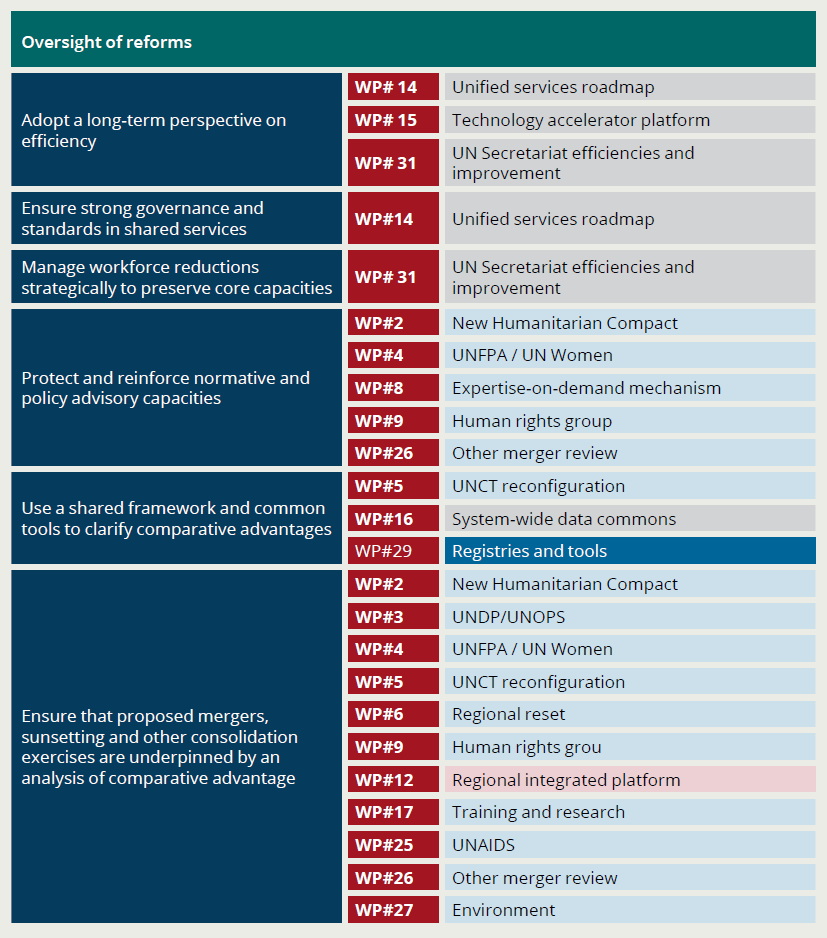
Reform oversight
MOPAN members and other Member States, through governing bodies, UN committees, and reform working groups, can influence how the system is reshaped:
• Adopt a long-term perspective on efficiency: Scrutinise proposed cost-cutting measures for their impact on future delivery and system-wide effectiveness, not just immediate savings.
▪ Ensure strong governance and standards in shared services: When consolidating administrative functions (finance, HR, procurement, etc.) across or within agencies, robust governance arrangements must be in place to uphold service quality and accountability. Member States should advocate for harmonised definitions of administrative costs and quality indicators across the UN system, so that efficiency gains do not come at the expense of effectiveness. Regular monitoring and reporting on the performance of shared service hubs should be mandated to catch and correct issues early.
▪ Manage workforce reductions strategically to preserve core capacities: Where functions are being restructured or relocated for efficiency, UN entities should be guided by strategic workforce planning to retain essential skills and institutional memory. Member states should request evidence that downsizing or relocation proposals include plans to safeguard critical oversight, risk management, and technical expertise.
▪ Protect and reinforce normative and policy advisory capacities: UN entities should allocate sufficient resources to policy advice, normative support, and capacity development, which are often underfunded but critical for lasting impact. This may require revisiting cost-recovery policies and overhead structures. In parallel, entities should be encouraged to proactively strengthen in-house policy expertise, including through staff development, knowledge partnerships, and better leveraging of regional advisors.
▪ Use a shared framework and common tools to clarify comparative advantages. Member states should encourage the adoption of a common approach to defining and assessing comparative advantage to systematically map core functions, thematic areas and organisational attributes, thereby revealing overlaps and gaps more clearly. Member states should require multilateral organisations to articulate their comparative advantage from a system-wide perspective in strategic plans, funding agreements and dialogue forums. Donors can also support the harmonisation of analytical tools (for example, unified reporting standards or shared data platforms) to enable comparisons and reduce fragmented assessments.
▪ Ensure that proposed mergers, sunsetting, and other consolidation exercises are underpinned by an analysis of comparative advantage, to preserve and enhance critical functions and organisational attributes rather than deplete them. Member States should insist that decisions be guided by evidence of where consolidation would genuinely improve both efficiency and effectiveness, rather than where entities are better kept distinct.
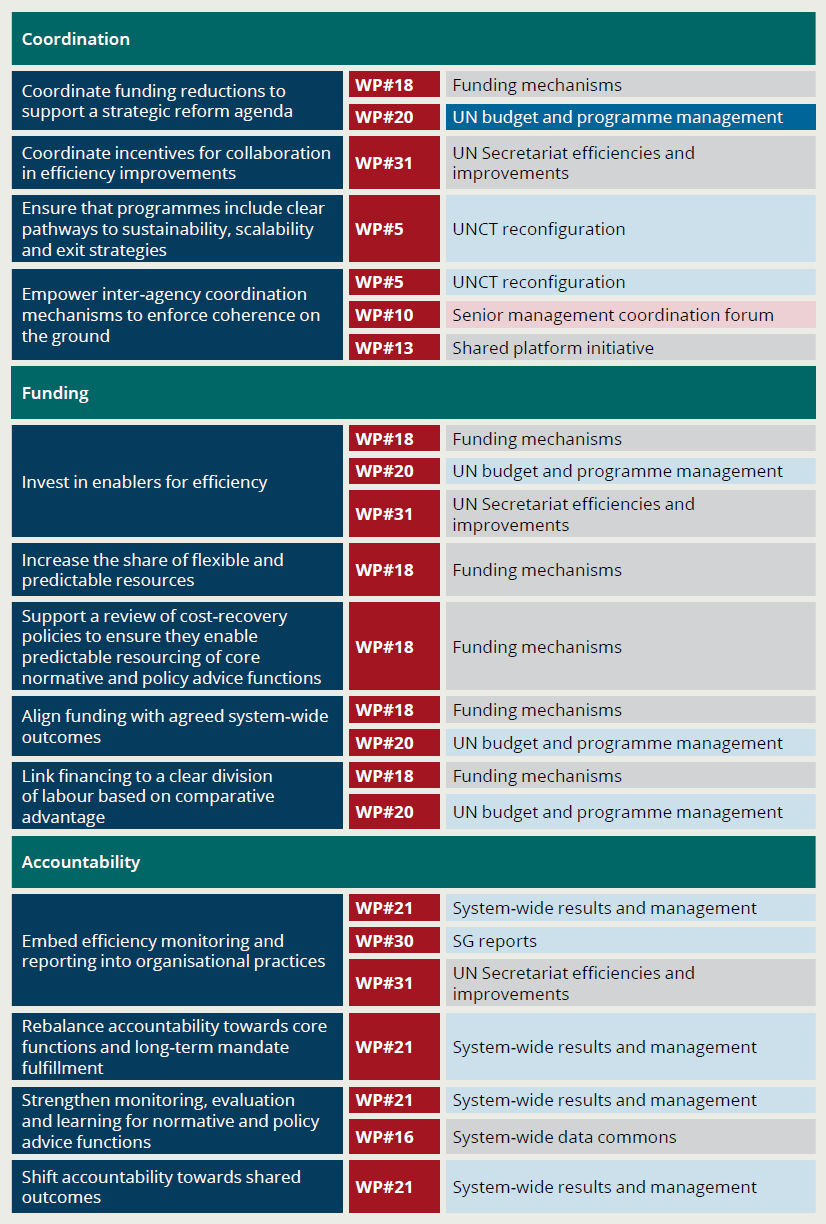
Co-ordination
▪ Co-ordinate funding reductions to support a strategic reform agenda. MOPAN members and other donors should move away from unilateral and fragmented cuts and instead engage in a joined-up dialogue to guide reforms. A coherent, collective approach can prevent reactive measures that undermine long-term capacity.
▪ Co-ordinate incentives for collaboration in efficiency improvements: Efficiency should not be pursued in silos. Donors should encourage inter-agency collaboration, such as shared back offices or joint procurement initiatives, by adequately funding them and rewarding participating agencies. Likewise, any efficiency-related conditionality or targets set by governing bodies should take into account collective efforts.
▪ In country-level planning (UN Sustainable Development Cooperation Frameworks and similar), Member States and UN leaders must ensure that programmes include clear pathways to sustainability, scalability and exit strategies. This might involve setting criteria that new initiatives demonstrate how they will strengthen local institutions or policies, not just deliver services.
▪ Empower inter-agency co-ordination mechanisms to enforce coherence on the ground. Member states should consider providing political backing and resources to Resident Coordinators (RCs), UN country teams, and humanitarian cluster leads to enable them to act as arbiters of comparative advantage in the field. Additionally, supporting nationally led country platforms that bring together the UN, multilateral development banks, vertical funds, and local actors can drive coherent action on complex issues (such as climate, health, or crisis recovery) based on each partner’s strengths.
Funding
▪ Invest in enablers of efficiency. Reforms such as administrative consolidation, shared services, or digitalisation require upfront investment and change management – they should be supported with adequate resources and time to mature.
▪ Increase the share of flexible, predictable resources to deliver on commitments made in the Funding Compact. Multi-year, flexible funding streams enable better planning and help organisations sustain key advisory and co-ordination functions during crises. In the current environment, this type of funding is essential to avoid a disproportionate erosion of core functions – including oversight and evaluation - when cuts hit.
▪ Support a review of cost-recovery policies to ensure they enable predictable resourcing of core normative and policy advice functions. While a larger share of flexible resources that could be used for this purpose has not been mobilised, and regional capacities have not been leveraged as initially envisaged, reviewing cost-recovery policies could enable UN entities to allocate sufficient resources to policy advice.
▪ Align funding with agreed system-wide outcomes: When providing earmarked funds, donors should ensure these investments reinforce collectively agreed results at the country or global level, rather than promoting standalone projects. Funding decisions should be informed by UN country frameworks (UNSDCFs) and Humanitarian Response Plans based on joint assessments of needs. Increasing the share of funding provided through pooled funding tied to multi-agency outcomes in certain sectors or thematic areas would provide additional incentives for collaboration towards shared outcomes, based on comparative advantage.
▪ Link financing to a clear division of labour based on comparative advantage. In practice, this might mean pooling funds for cross-cutting initiatives, expanding support to multi-partner trust funds, and avoiding funding multiple agencies to do similar work in the same country without co-ordination.
Accountability
▪ Embed efficiency monitoring and reporting into organisational practices: Agencies should develop clear definitions and metrics of efficiency (e.g. cost per output, processing times, overhead ratios) and integrate these into their corporate scorecards and project monitoring systems. Member States should insist on greater transparency in how efficiency gains are measured and used.
▪ Rebalance accountability toward core functions and long-term mandate fulfilment: Member States should use the UN80 mandate review process to address the bias toward short-term project outputs within the system. This starts with greater budget transparency into how resources are allocated across core functions, including normative and policy advice. Member states should require multilateral organisations to report expenditures by function and improve results reporting to focus on mandate-related outcomes (see below).
▪ Strengthen monitoring, evaluation and learning for normative and policy advice functions: To close the mandate-results gap, organisations should enhance their monitoring and evaluation systems to better capture the outcomes of normative and policy work. Donors can support by funding joint evaluations of these functions.
▪ Shift accountability towards shared outcomes: To truly change behaviour, the accountability frameworks for multilateral organisations should evolve to include joint results and collective impact measures. MOPAN members can spearhead this by encouraging the development of joint performance indicators (for example, under the UNSDCF results matrix) and by considering incentives such as pooled performance-based funding that rewards effective collaboration. They could also commission more system-wide evaluations that look at how agencies work together to achieve country outcomes, building on the work of the UN System-Wide Evaluation Office (SWEO) and IASC evaluations (in the humanitarian sector), and ensure that their recommendations are appropriately followed up on.
The figure below (figure 1) illustrates the UN80 Action Plan work packages to which each MOPAN recommendation in this paper applies.
Figure 1. MOPAN Recommendations and related UN80 work packages
References
1. UN80’s workstreams focus on: (1) driving efficiencies and improvements (with cost-saving proposals already feeding into a revised Programme Budget for 2026); (2) reviewing mandate implementation; and (3) pursuing structural and programmatic realignments. To ensure system-wide engagement, the UN Secretary-General has set out a UN80 Initiative Action Plan and a dedicated implementation team to advance these reforms across the UN: