This report completes MOPAN’s three-part study of the global health architecture. It turns the evidence of Output 1 on mandates and Output 2 on comparative advantage into ten Reform Objectives. It identifies what should change, not a single route or sequence: those are political choices for governments, boards and funders.
A future global health architecture must respond to today’s geopolitical realities, evolving health needs, and changing financing landscape. With development assistance for health projected to decline by 19-33% from 2023 levels, countries are carrying more of the cost. MOPAN’s analysis finds that the nine organisations collectively cover much of what the six future global health functions require. The central challenge is in addressing how their capabilities are configured, financed and governed; how the burdens imposed by the current architecture on countries can be reduced; and how gaps in shared functions and system-wide stewardship can be addressed.
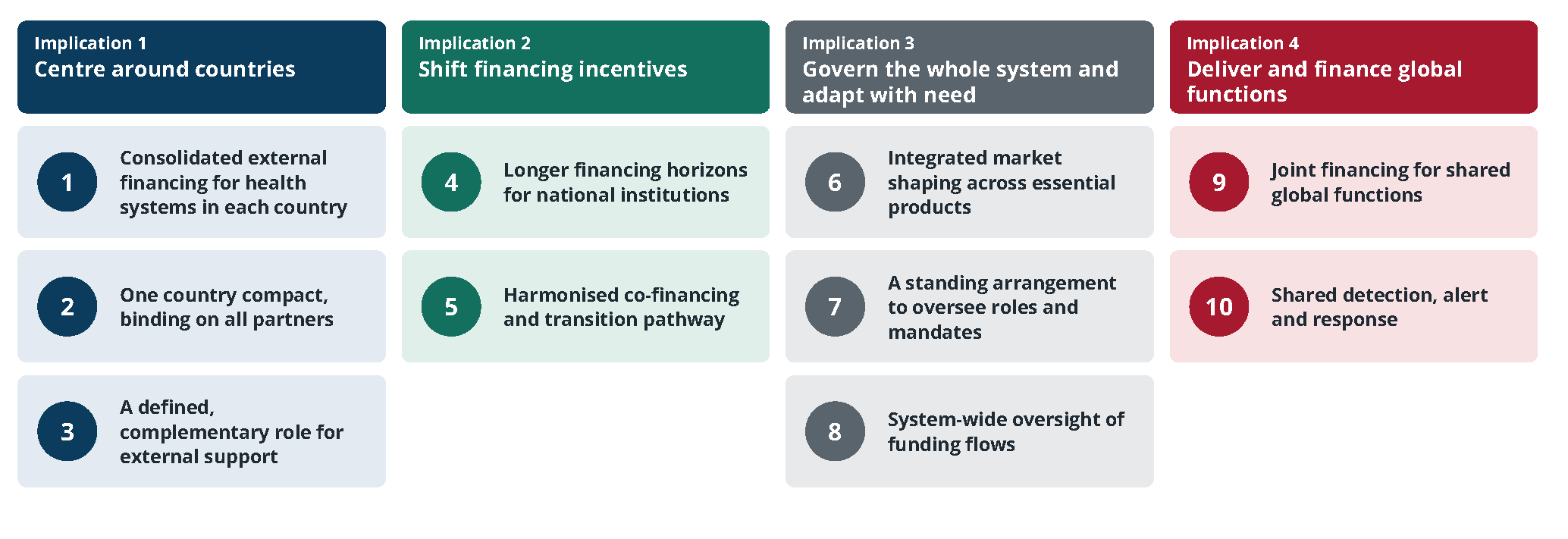
Two principles apply to every reform: build on comparative advantage, so that each organisation concentrates on what its mandate and design equip it to do and steps back where others are better placed; and protect what cannot readily be rebuilt, such as global standards, prequalification, emergency authority and global health data. The evidence leads to four Implications:
- Centre the future global health architecture around countries. External support for country health systems is not a coherent offer and can substitute for national systems; countries spend scarce capability managing separate external processes.
- Shift financing incentives and behaviours of external partners. Financing rewards results that organisations and funders can attribute to themselves, often over short cycles and around externally-driven priorities; and each funder times transition from its support on its own terms.
- Govern the global health system as a whole and adapt it as needs change. No organisation can steward the system as a whole or direct its independently governed peers; and roles, mandates and financing have not been designed collectively or adapted coherently to meet changes in future burden of disease and climate-related health risk.
- Deliver and finance global functions and global public goods fairly and predictably. Norms and standards, prequalification, data and alerts are paid for by a few donors, cycle by cycle and mostly earmarked.
These Implications set the direction for ten Reform Objectives as follows: